Description
< #Remote Operations #SSH Client #SFTP Transfer #Port Tunnel #Serial Terminal #Rust #Tauri #Open Source
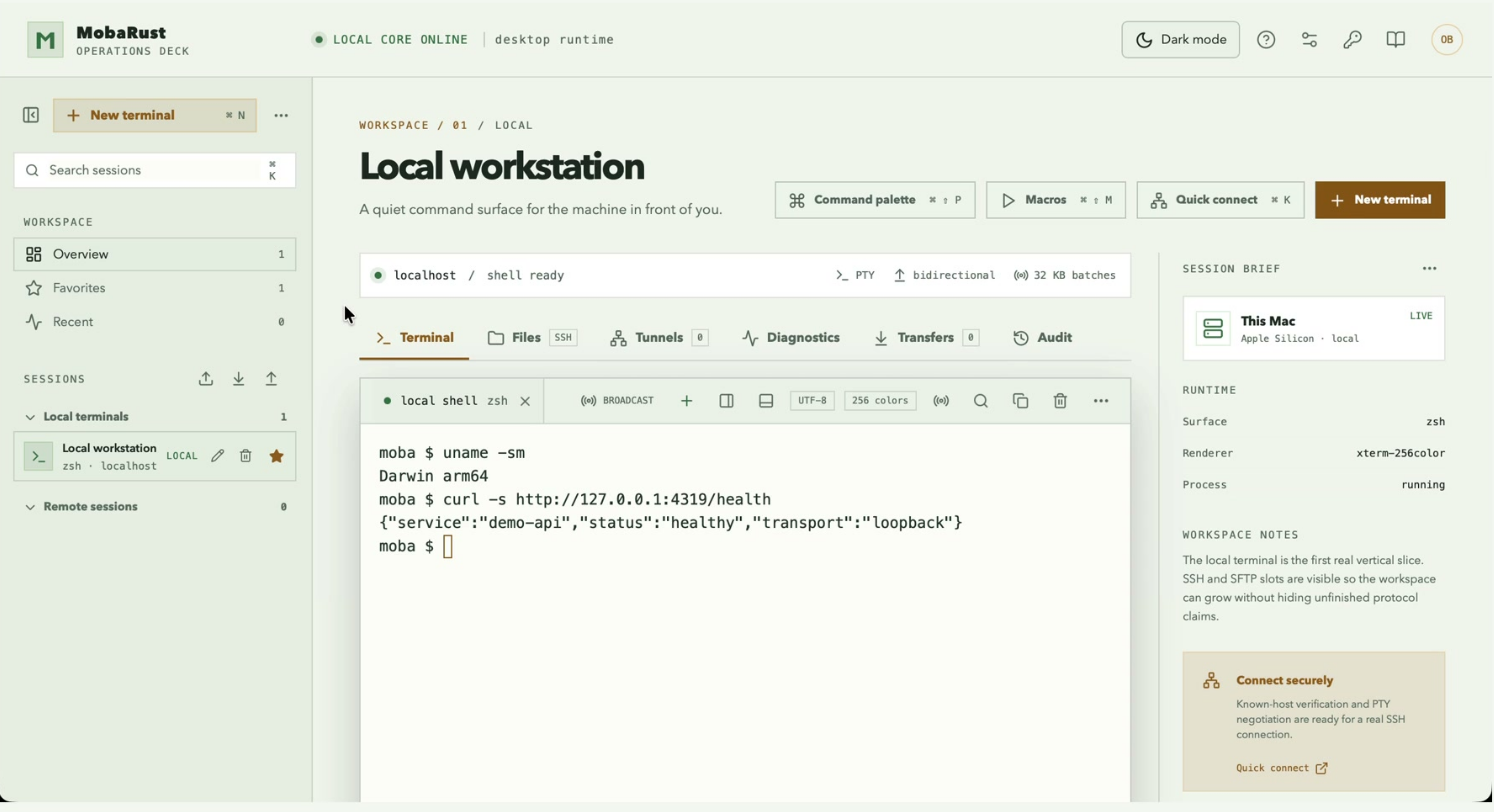
MobaRust is a free and open-source remote operations workstation built with Rust and Tauri. It gathers the tools of a daily remote workday — SSH terminals, SFTP/SCP transfers, port tunnels, serial and Telnet — into a single desktop window, and its author positions it squarely as an open-source MobaXterm alternative. React and TypeScript render the interface, while sockets, PTYs, file operations, child processes and credentials all live in the native Rust layer, so this is a real desktop application rather than a terminal-shaped web page.
It suits developers, sysadmins and homelab owners who hop between several machines all day. Reaching one server used to mean juggling a terminal, an SFTP client, a tunnel tool and a session list at the same time; MobaRust compresses connect, inspect, transfer, operate and disconnect into one window, and it stays local-first — no account, no subscription, with session profiles and keys kept on your own computer.
SSH terminal: Native SSH with host-key verification, password and key authentication, SSH-agent support, keyboard-interactive login, PTY resize, keepalives, cancellation and reconnect, plus error messages you can actually act on.
SFTP and SCP: A built-in remote file browser with recursive transfers, progress, cancellation, bounded concurrency, atomic commits, conflict handling and permission preservation, alongside native SCP compatibility.
Session manager: Save hosts as profiles, sort them into folders, add tags and favorites, browse recents and search fast, import an existing OpenSSH config, chain jump hosts, and export without dragging secrets along.
Port tunnels: Local forwarding, remote forwarding and a dynamic SOCKS5 proxy, each with a visible lifecycle state, a stop control and individually cancellable clients.
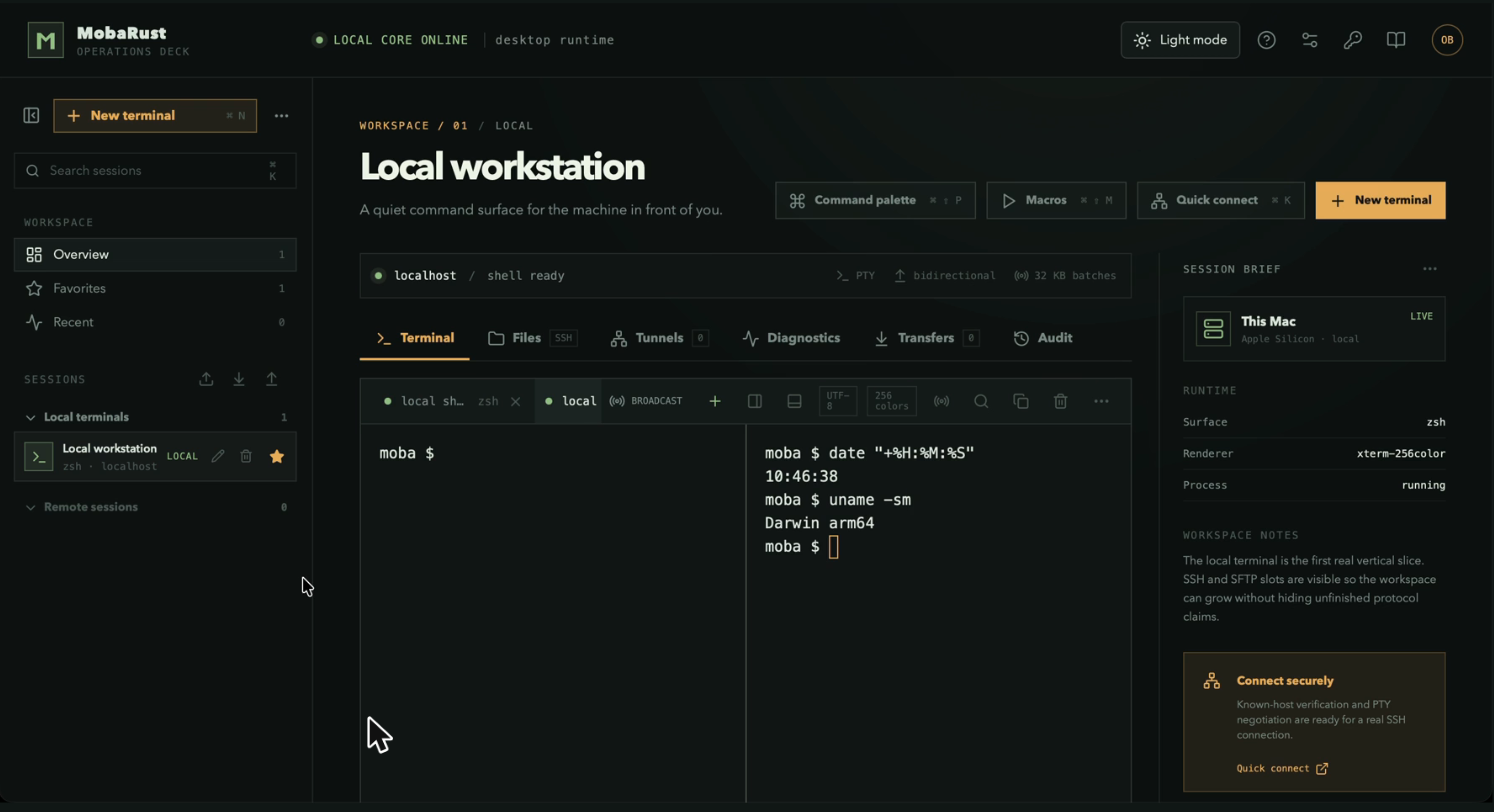
Local terminals: Native PTY shells with persistent tabs, split panes, resize and output batching; on Windows you can target PowerShell or cmd explicitly, and every installed Unix shell can be launched directly.
Serial and Telnet: Serial configuration, terminal I/O, refresh, reconnect and device-loss handling for hardware work, plus legacy Telnet that is clearly labelled as an unencrypted connection.
Operator tools: Snippets carry descriptions, tags and variables such as ${host} and can be previewed before sending; macros stay visible and cancellable; multi-exec demands explicit target selection and offers an emergency stop; network diagnostics, port checks, low-frequency remote monitoring and sanitized diagnostic exports round it out.
Credential isolation: A session stores only an opaque credential reference — the real password or private key is resolved inside the native Rust boundary when a protocol needs it and handed to helpers through a dedicated pipe, never through process arguments or logs.
Open source: The source code is hosted on GitHub, so developers can study the implementation, contribute, or customize it for their own needs.
MobaRust is a free and open-source remote operations workstation built with Rust and Tauri. It gathers the tools of a daily remote workday — SSH terminals, SFTP/SCP transfers, port tunnels, serial and Telnet — into a single desktop window, and its author positions it squarely as an open-source MobaXterm alternative. React and TypeScript render the interface, while sockets, PTYs, file operations, child processes and credentials all live in the native Rust layer, so this is a real desktop application rather than a terminal-shaped web page.
It suits developers, sysadmins and homelab owners who hop between several machines all day. Reaching one server used to mean juggling a terminal, an SFTP client, a tunnel tool and a session list at the same time; MobaRust compresses connect, inspect, transfer, operate and disconnect into one window, and it stays local-first — no account, no subscription, with session profiles and keys kept on your own computer.
Features
SSH terminal: Native SSH with host-key verification, password and key authentication, SSH-agent support, keyboard-interactive login, PTY resize, keepalives, cancellation and reconnect, plus error messages you can actually act on.
SFTP and SCP: A built-in remote file browser with recursive transfers, progress, cancellation, bounded concurrency, atomic commits, conflict handling and permission preservation, alongside native SCP compatibility.
Session manager: Save hosts as profiles, sort them into folders, add tags and favorites, browse recents and search fast, import an existing OpenSSH config, chain jump hosts, and export without dragging secrets along.
Port tunnels: Local forwarding, remote forwarding and a dynamic SOCKS5 proxy, each with a visible lifecycle state, a stop control and individually cancellable clients.
Local terminals: Native PTY shells with persistent tabs, split panes, resize and output batching; on Windows you can target PowerShell or cmd explicitly, and every installed Unix shell can be launched directly.
Serial and Telnet: Serial configuration, terminal I/O, refresh, reconnect and device-loss handling for hardware work, plus legacy Telnet that is clearly labelled as an unencrypted connection.
Operator tools: Snippets carry descriptions, tags and variables such as ${host} and can be previewed before sending; macros stay visible and cancellable; multi-exec demands explicit target selection and offers an emergency stop; network diagnostics, port checks, low-frequency remote monitoring and sanitized diagnostic exports round it out.
Credential isolation: A session stores only an opaque credential reference — the real password or private key is resolved inside the native Rust boundary when a protocol needs it and handed to helpers through a dedicated pipe, never through process arguments or logs.
Open source: The source code is hosted on GitHub, so developers can study the implementation, contribute, or customize it for their own needs.