Description
FFmpeg is the infrastructure behind audio and video processing. There is no window: it is a set of command line programs plus the libraries underneath them — ffmpeg converts and processes, ffplay plays, ffprobe tells you what is actually inside a file.
Nearly every piece of software that touches video — players, editors, screen recorders, online transcoding services — is using it somewhere below the surface. Used directly it converts formats, shrinks files, cuts clips, extracts audio, burns subtitles, pulls frames and changes resolution, each in a single command that can then be scripted across hundreds of files. Learn a handful of invocations and a lot of jobs that seem to need dedicated software become one line of text.
Format conversion: Its decoder and encoder coverage is enormous, so almost any container and codec can be read and written, whether you are changing wrapper or re-encoding.
Cutting and joining: Extract a segment by timecode or concatenate several into one — done in seconds and without quality loss when no re-encoding is needed.
Filter system: Scaling, cropping, rotation, speed changes, watermarks, burnt-in subtitles, denoising and colour work are all filters, chainable into one pass.
Streaming: It pulls and pushes RTMP, RTSP and HLS streams, which covers both restreaming and recording.
Hardware acceleration: GPU encoders and decoders can be used, which is far quicker than the CPU alone on long material.
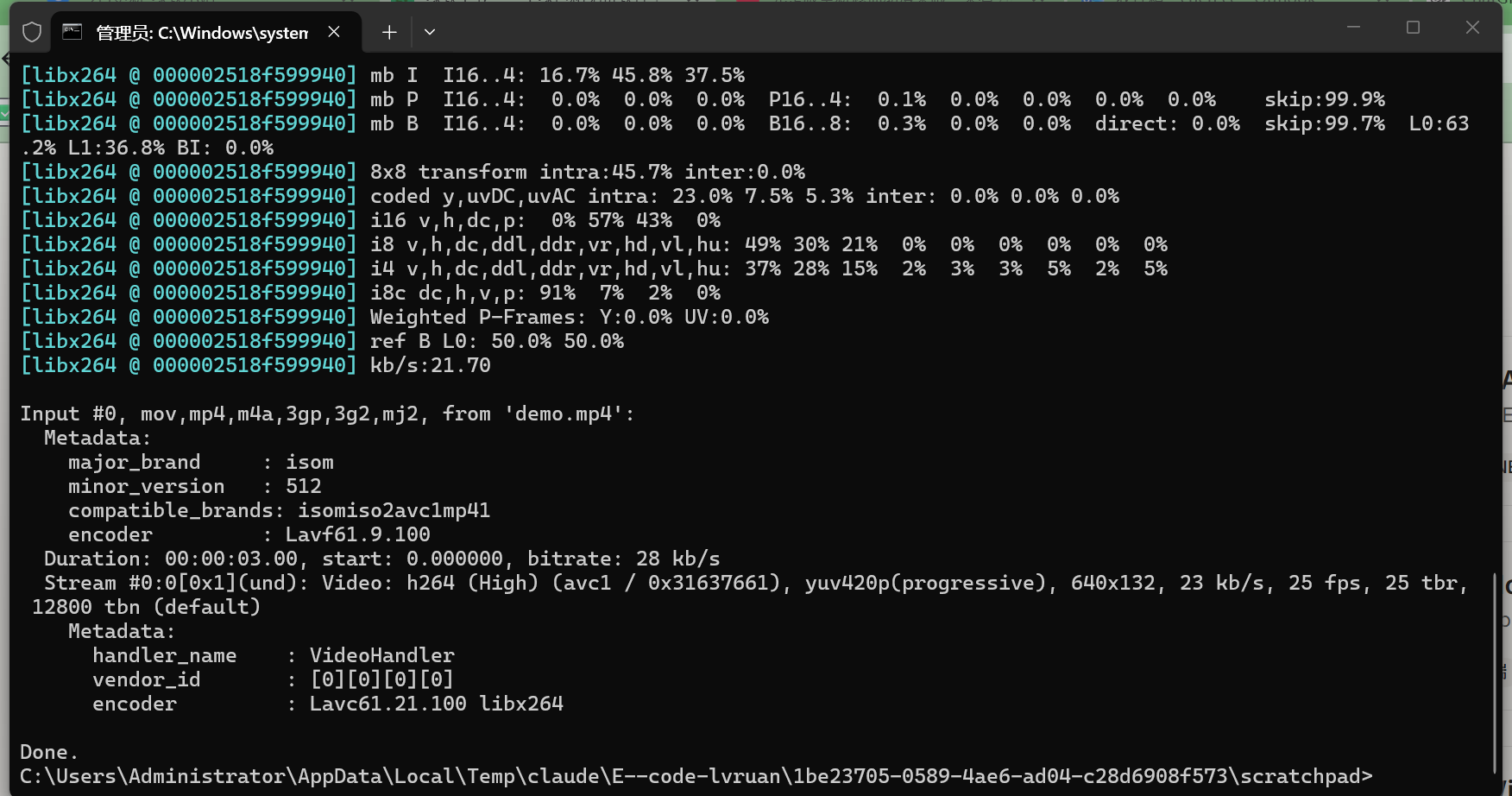
File inspection: ffprobe lists the container, every stream’s codec, resolution, bitrate, duration and metadata — the natural first step when something is wrong.
Built for batches: Being pure command line, it drops into scripts and scheduled jobs, so hundreds of files run through the same parameters unattended.
Nearly every piece of software that touches video — players, editors, screen recorders, online transcoding services — is using it somewhere below the surface. Used directly it converts formats, shrinks files, cuts clips, extracts audio, burns subtitles, pulls frames and changes resolution, each in a single command that can then be scripted across hundreds of files. Learn a handful of invocations and a lot of jobs that seem to need dedicated software become one line of text.
Features
Format conversion: Its decoder and encoder coverage is enormous, so almost any container and codec can be read and written, whether you are changing wrapper or re-encoding.
Cutting and joining: Extract a segment by timecode or concatenate several into one — done in seconds and without quality loss when no re-encoding is needed.
Filter system: Scaling, cropping, rotation, speed changes, watermarks, burnt-in subtitles, denoising and colour work are all filters, chainable into one pass.
Streaming: It pulls and pushes RTMP, RTSP and HLS streams, which covers both restreaming and recording.
Hardware acceleration: GPU encoders and decoders can be used, which is far quicker than the CPU alone on long material.
File inspection: ffprobe lists the container, every stream’s codec, resolution, bitrate, duration and metadata — the natural first step when something is wrong.
Built for batches: Being pure command line, it drops into scripts and scheduled jobs, so hundreds of files run through the same parameters unattended.