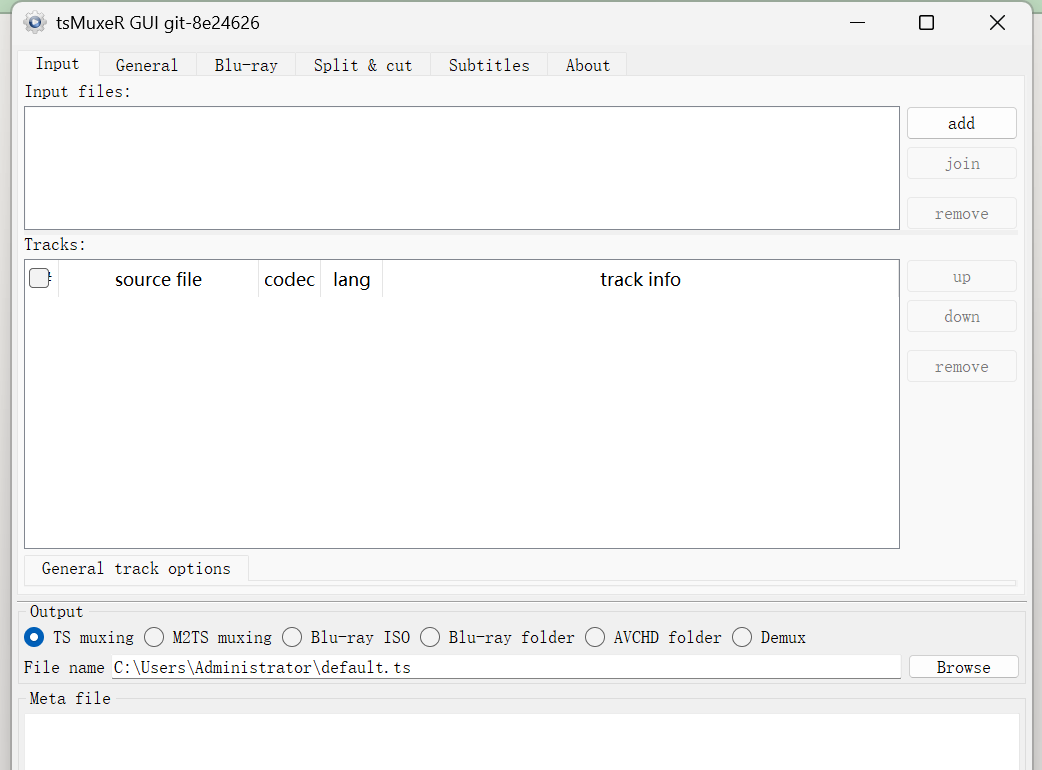
Description
tsMuxeR is a remuxing tool that repacks video and audio into a different container. The point is that it does not re-encode — the original picture and sound are carried across untouched, so it is fast and lossless, and a feature-length film is done in minutes.
The usual jobs are turning an MKV into the M2TS a Blu-ray player expects, or going the other way and pulling the tracks out of a Blu-ray. It can also produce a Blu-ray ISO or an AVCHD folder structure directly, ready to burn or copy onto a player. There is a command line build and a GUI, the latter putting track selection, cutting and delay adjustment behind a window.
Lossless remuxing: Only the container changes, so output is bit-for-bit the same quality as the source and the time taken depends on disk speed rather than the CPU.
Wide format coverage: Input can be MKV, MP4/MOV, TS/M2TS, EVO/VOB/MPG or raw elementary streams, with H.264, H.265, VC-1 and MPEG-2 video and AAC, AC3/E-AC3 and DTS/DTS-HD audio.
Blu-ray output: It writes Blu-ray ISOs, Blu-ray folders and AVCHD directories complete with menu and chapter structure, which hardware players recognise.
Track selection: With multi-audio, multi-subtitle sources you tick exactly which tracks to keep, and set language flags and the default track yourself.
Cutting and joining: Split at chosen timecodes or join several parts into one, which makes trimming an intro or an outro straightforward.
Audio delay: Apply a positive or negative delay to an individual audio track, fixing out-of-sync sound without re-encoding anything.
The usual jobs are turning an MKV into the M2TS a Blu-ray player expects, or going the other way and pulling the tracks out of a Blu-ray. It can also produce a Blu-ray ISO or an AVCHD folder structure directly, ready to burn or copy onto a player. There is a command line build and a GUI, the latter putting track selection, cutting and delay adjustment behind a window.
Features
Lossless remuxing: Only the container changes, so output is bit-for-bit the same quality as the source and the time taken depends on disk speed rather than the CPU.
Wide format coverage: Input can be MKV, MP4/MOV, TS/M2TS, EVO/VOB/MPG or raw elementary streams, with H.264, H.265, VC-1 and MPEG-2 video and AAC, AC3/E-AC3 and DTS/DTS-HD audio.
Blu-ray output: It writes Blu-ray ISOs, Blu-ray folders and AVCHD directories complete with menu and chapter structure, which hardware players recognise.
Track selection: With multi-audio, multi-subtitle sources you tick exactly which tracks to keep, and set language flags and the default track yourself.
Cutting and joining: Split at chosen timecodes or join several parts into one, which makes trimming an intro or an outro straightforward.
Audio delay: Apply a positive or negative delay to an individual audio track, fixing out-of-sync sound without re-encoding anything.