Description
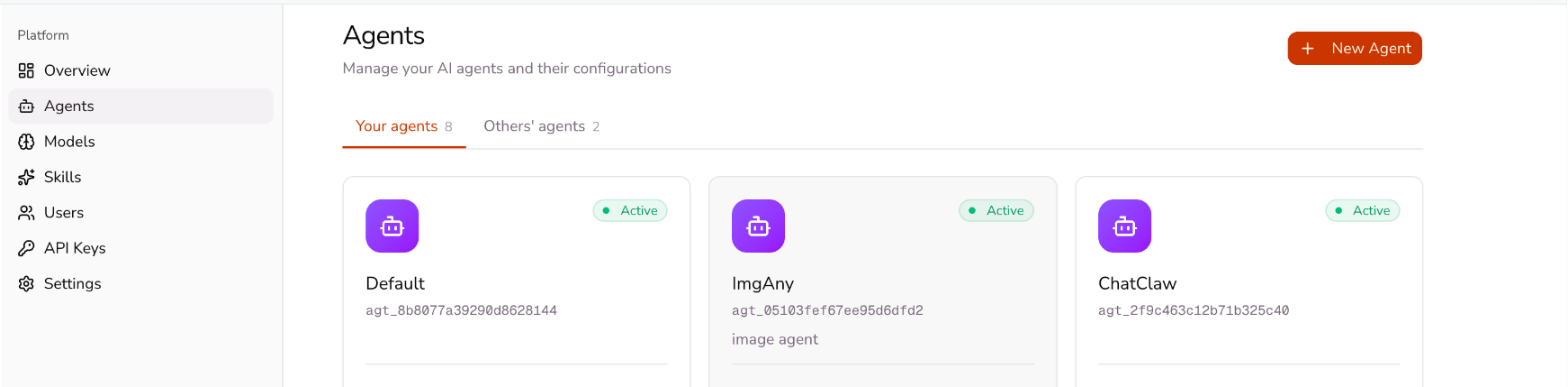
FastClaw is an agent factory written in Go, shipped as a single binary you drop onto a machine and run with no dependency stack to assemble first. It is positioned not as one agent but as the place where agents get built and distributed: in its console an agent is a first-class object, each with its own model, personality definition, skills and memory, independent of the others.
For getting them out into the world it offers a few routes: bind one to Telegram, Discord or Slack as a bot, with context isolated per channel and per conversation; or expose it through an OpenAI-compatible endpoint so another product can treat it as an agent runtime, leaving code that already talks to an LLM largely unchanged. Installed locally it is an internal team of agents; deployed to a server it becomes an agent platform for others.
The licence deserves attention: the base is Apache 2.0 with additional conditions. Internal use, and using it as the backend of your own SaaS product, need no extra permission. Hosting it as a multi-tenant service and selling access to unrelated organisations — that is, running a competing agent platform — does require a commercial licence from the copyright holder, and the FastClaw branding may not be removed from the frontend.
Multi-agent management: One instance holds many agents, each with its own personality file, memory, skills and tools, and each free to use a different model.
Provider-agnostic: OpenAI, Anthropic, Ollama, OpenRouter, Groq, DeepSeek, Mistral and any OpenAI-compatible service all work, with per-agent overrides and prompt caching.
Chat channel bindings: An agent can be bound directly as a Telegram, Discord or Slack bot, with sessions kept separate per channel and per conversation so threads never bleed together.
Tools and sandbox: Command execution, file and web tools are built in and can run inside an E2B cloud sandbox or Docker, with the workspace synchronised before and after execution.
Skills and plugins: Skills install from a shared registry or from GitHub and can be enabled per agent or globally, alongside MCP server support and a JSON-RPC plugin system.
Long-term memory: Memory lives in a file that updates itself over time and pairs with full session history, so an agent retains what happened earlier.
Compatible API output: It serves an OpenAI-format chat completions endpoint, which lets other products plug it in wherever they already point at a model.
Single-binary deployment: One Go binary with no extra dependencies, the same artefact locally and in the cloud.
For getting them out into the world it offers a few routes: bind one to Telegram, Discord or Slack as a bot, with context isolated per channel and per conversation; or expose it through an OpenAI-compatible endpoint so another product can treat it as an agent runtime, leaving code that already talks to an LLM largely unchanged. Installed locally it is an internal team of agents; deployed to a server it becomes an agent platform for others.
The licence deserves attention: the base is Apache 2.0 with additional conditions. Internal use, and using it as the backend of your own SaaS product, need no extra permission. Hosting it as a multi-tenant service and selling access to unrelated organisations — that is, running a competing agent platform — does require a commercial licence from the copyright holder, and the FastClaw branding may not be removed from the frontend.
Features
Multi-agent management: One instance holds many agents, each with its own personality file, memory, skills and tools, and each free to use a different model.
Provider-agnostic: OpenAI, Anthropic, Ollama, OpenRouter, Groq, DeepSeek, Mistral and any OpenAI-compatible service all work, with per-agent overrides and prompt caching.
Chat channel bindings: An agent can be bound directly as a Telegram, Discord or Slack bot, with sessions kept separate per channel and per conversation so threads never bleed together.
Tools and sandbox: Command execution, file and web tools are built in and can run inside an E2B cloud sandbox or Docker, with the workspace synchronised before and after execution.
Skills and plugins: Skills install from a shared registry or from GitHub and can be enabled per agent or globally, alongside MCP server support and a JSON-RPC plugin system.
Long-term memory: Memory lives in a file that updates itself over time and pairs with full session history, so an agent retains what happened earlier.
Compatible API output: It serves an OpenAI-format chat completions endpoint, which lets other products plug it in wherever they already point at a model.
Single-binary deployment: One Go binary with no extra dependencies, the same artefact locally and in the cloud.