Description
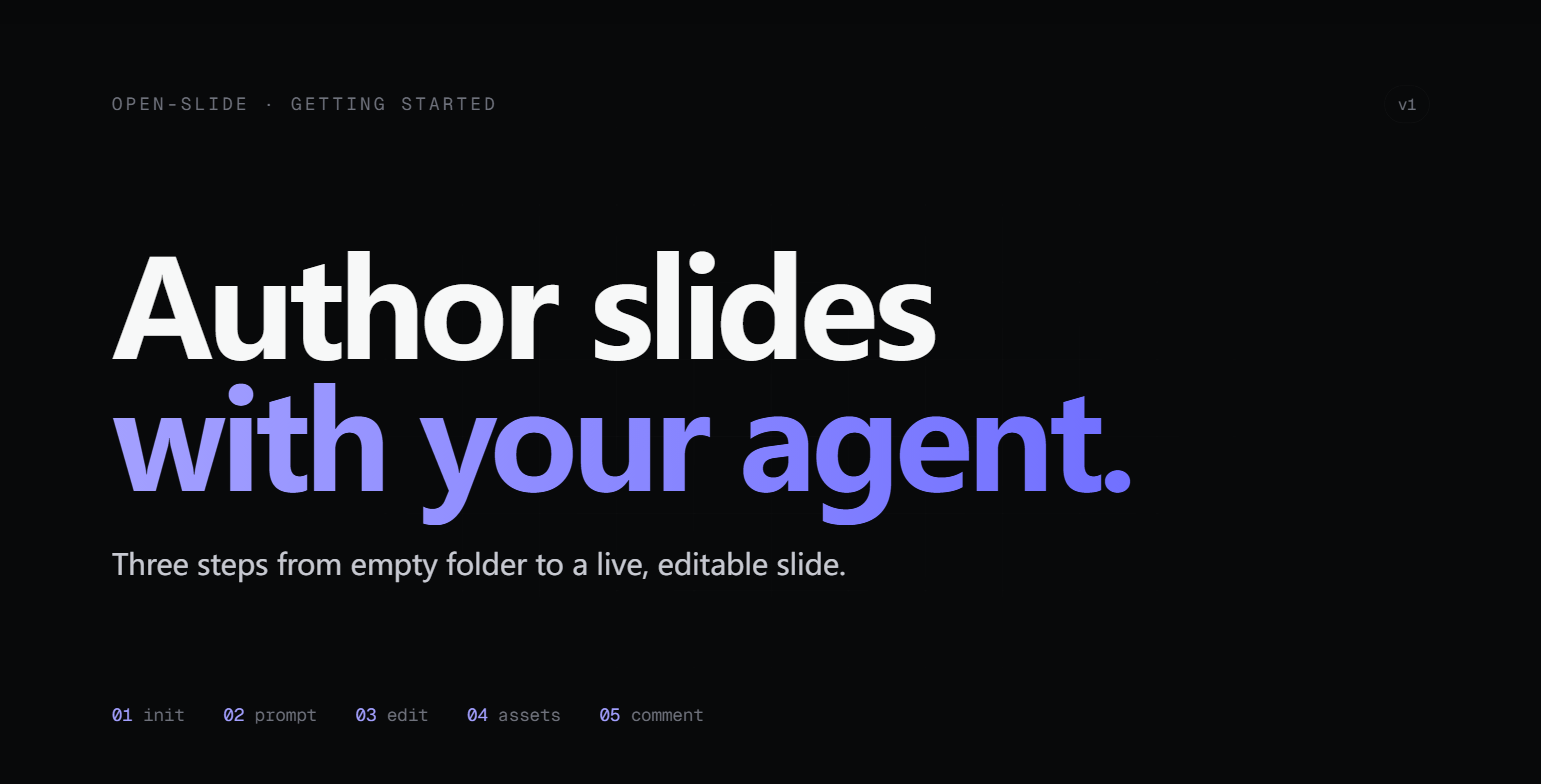
open-slide is a slide framework meant to be driven by an AI agent. You describe what the talk should cover and the agent writes the pages, instead of you adjusting font sizes and nudging images into alignment.
What makes that workable is a structural choice: every page is a fixed 1920×1080 canvas whose content is arbitrary React components rather than placeholders in a constrained template language. For an agent that writes code, layout therefore becomes something expressible in code — anything can go anywhere, with no template quirks to work around. The project ships two skill files: one for drafting a whole deck from nothing, the other a technical reference covering canvas size, type scale, colour and layout rules, which keeps the agent from drifting.
Revising changes shape too: click an element in the browser preview and leave a note, collect several, then have the agent apply them all in one pass instead of editing page by page.
Pages are code: Each page is a fixed 1920×1080 canvas written as React components, giving the same layout freedom as building a web page rather than filling in a template.
Bundled agent skills: A drafting skill and a layout-specification skill ship with the project, so the agent knows which canvas size, type scale and palette to work to.
Annotation-based revision: Select an element in the preview and write a note; a batch of notes then goes to the agent to execute at once, which beats editing slide by slide.
Asset management: Dedicated panels handle images, video and fonts, and brand logos can be searched straight from the svgl icon catalogue.
Presenter mode: While presenting you see the current slide, a preview of the next one, your notes and a timer together.
Two export paths: Export a self-contained static site that becomes a shareable link on any static host, or a printable PDF.
What makes that workable is a structural choice: every page is a fixed 1920×1080 canvas whose content is arbitrary React components rather than placeholders in a constrained template language. For an agent that writes code, layout therefore becomes something expressible in code — anything can go anywhere, with no template quirks to work around. The project ships two skill files: one for drafting a whole deck from nothing, the other a technical reference covering canvas size, type scale, colour and layout rules, which keeps the agent from drifting.
Revising changes shape too: click an element in the browser preview and leave a note, collect several, then have the agent apply them all in one pass instead of editing page by page.
Features
Pages are code: Each page is a fixed 1920×1080 canvas written as React components, giving the same layout freedom as building a web page rather than filling in a template.
Bundled agent skills: A drafting skill and a layout-specification skill ship with the project, so the agent knows which canvas size, type scale and palette to work to.
Annotation-based revision: Select an element in the preview and write a note; a batch of notes then goes to the agent to execute at once, which beats editing slide by slide.
Asset management: Dedicated panels handle images, video and fonts, and brand logos can be searched straight from the svgl icon catalogue.
Presenter mode: While presenting you see the current slide, a preview of the next one, your notes and a timer together.
Two export paths: Export a self-contained static site that becomes a shareable link on any static host, or a printable PDF.