Description
< #AI Art #Text to Image #Stable Diffusion #Midjourney Alternative #Offline #Open Source
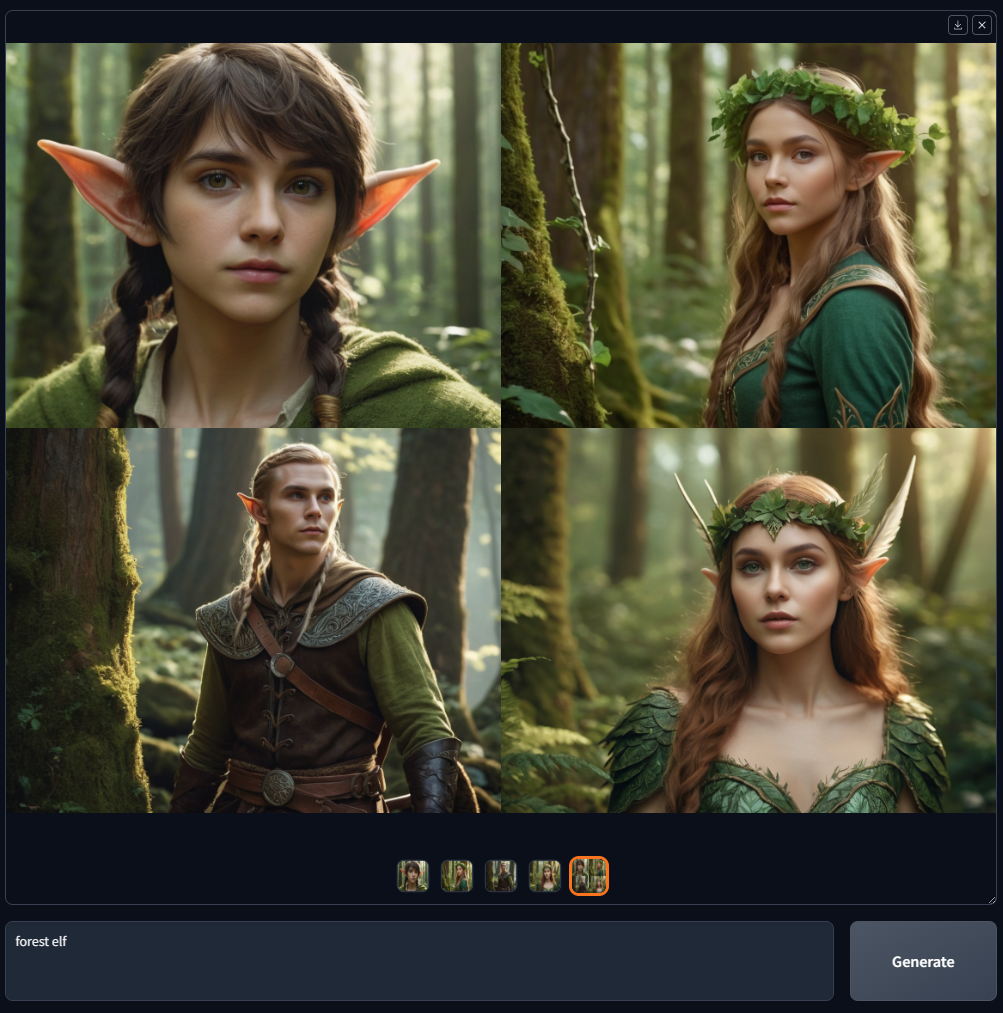
Fooocus generates images of Midjourney-like quality on your own GPU, and while Midjourney costs thirty dollars a month, this charges nothing and has no limit. It is built on the Stable Diffusion XL architecture with a Gradio interface and runs entirely offline once installed.
Its design intent is explicit: hide the parameter tuning so users only think about prompts and images. An offline GPT-2 based prompt processing engine and many sampling improvements keep results good whether the prompt is as short as "house in garden" or a thousand words long. Installation is minimized too — fewer than three mouse clicks between downloading and the first image, on as little as 4GB of Nvidia VRAM.
No parameter tuning: samplers, CFG and the rest stay out of the way; write the prompt and generate, because the defaults are already the tuned configuration.
Variation and upscaling: take a generated image through Vary (subtle or strong) and Upscale (1.5x or 2x), the equivalent of Midjourney's V and U actions.
Inpaint and outpaint: repaint regions or extend the canvas up, down, left and right using the project's own inpainting algorithm and models, which give better results than the standard SDXL approach.
Image prompting: an in-house image prompt algorithm reads reference images, InsightFace powers face swapping, and Describe recovers a prompt from an existing picture.
Styles and framing: the advanced panel offers preset styles, aspect ratios, image counts, quality levels and negative prompts, matching Midjourney's --style, --ar and --no.
A1111-compatible prompt weights: syntax such as `(happy:1.5)` and embedding calls work, so prompts copied straight from Civitai behave as intended.
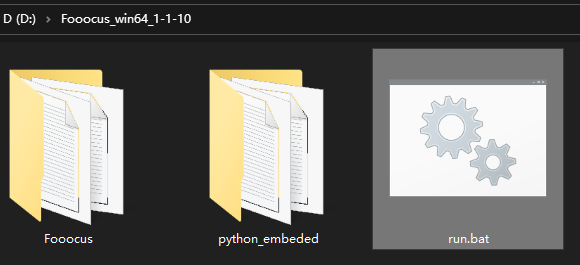
Three launchers: run.bat, run_anime.bat and run_realistic.bat target general, anime and photorealistic output, with SDXL models from Civitai supported.
Offline and non-commercial: the software is fully offline and free, and the authors warn that search results such as fooocus.com, fooocus.net and fooocus.ai are all fake sites — the GitHub repository is the only official source.
Open source project: the code is hosted on GitHub and is now in long-term support with bug fixes only, with no plans to move to newer model architectures; for models like Flux the authors point to WebUI Forge or the community's ComfyUI. The source remains open for developers to review, contribute to, or customize.
Fooocus generates images of Midjourney-like quality on your own GPU, and while Midjourney costs thirty dollars a month, this charges nothing and has no limit. It is built on the Stable Diffusion XL architecture with a Gradio interface and runs entirely offline once installed.
Its design intent is explicit: hide the parameter tuning so users only think about prompts and images. An offline GPT-2 based prompt processing engine and many sampling improvements keep results good whether the prompt is as short as "house in garden" or a thousand words long. Installation is minimized too — fewer than three mouse clicks between downloading and the first image, on as little as 4GB of Nvidia VRAM.
Features
No parameter tuning: samplers, CFG and the rest stay out of the way; write the prompt and generate, because the defaults are already the tuned configuration.
Variation and upscaling: take a generated image through Vary (subtle or strong) and Upscale (1.5x or 2x), the equivalent of Midjourney's V and U actions.
Inpaint and outpaint: repaint regions or extend the canvas up, down, left and right using the project's own inpainting algorithm and models, which give better results than the standard SDXL approach.
Image prompting: an in-house image prompt algorithm reads reference images, InsightFace powers face swapping, and Describe recovers a prompt from an existing picture.
Styles and framing: the advanced panel offers preset styles, aspect ratios, image counts, quality levels and negative prompts, matching Midjourney's --style, --ar and --no.
A1111-compatible prompt weights: syntax such as `(happy:1.5)` and embedding calls work, so prompts copied straight from Civitai behave as intended.
Three launchers: run.bat, run_anime.bat and run_realistic.bat target general, anime and photorealistic output, with SDXL models from Civitai supported.
Offline and non-commercial: the software is fully offline and free, and the authors warn that search results such as fooocus.com, fooocus.net and fooocus.ai are all fake sites — the GitHub repository is the only official source.
Open source project: the code is hosted on GitHub and is now in long-term support with bug fixes only, with no plans to move to newer model architectures; for models like Flux the authors point to WebUI Forge or the community's ComfyUI. The source remains open for developers to review, contribute to, or customize.