Description
< #Local LLM #RAG #MCP #AI Workspace #llama.cpp #Knowledge Base #Privacy First #Open Source
Vyact is a local-first personal AI workspace that gathers conversations, documents, notes and everyday tools into one window. It is built around llama.cpp and MLX on Apple Silicon, so models run on your own machine and chat context need not be handed to an outside provider — though OpenAI, Gemini, Claude or any OpenAI-compatible endpoint of your own can be connected when a task calls for it. The problem it targets is the ritual of hunting down a file and re-explaining the background every time a new chat starts.
Beyond chat it carries a full document-intelligence layer: an attachment can serve a single conversation or be indexed as long-term knowledge, grouped with memos and indexed email threads into knowledge collections so RAG stays narrowed to the material that matters, and every answer traces back to the passages behind it. Gmail, Outlook, Google Drive, OneDrive and calendars plug straight into the conversation, while a Chrome extension covers translation, rewriting and dual-subtitle study on Netflix. The desktop app is built on Electron with installers for macOS, Windows and Linux, released under AGPL-3.0, with an interface available in eight languages including Chinese.
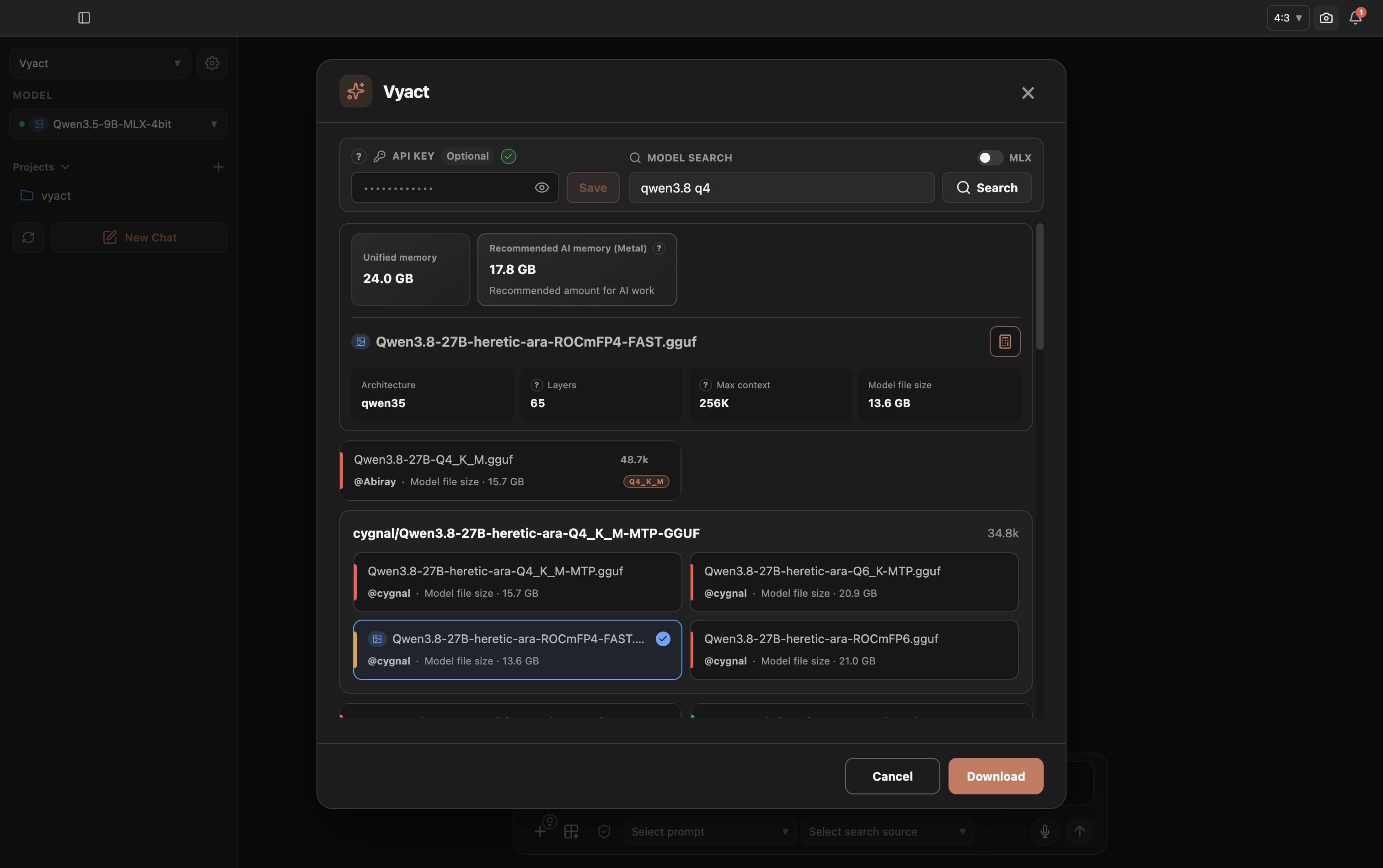
Local model management:Search and compare GGUF and MLX models in-app, weighing model size, quantization, context capacity and hardware-aware memory estimates against detected RAM and VRAM before downloading, after which Vyact installs the model and its matching runtime.
Settings benchmarks:The performance test in model settings runs each candidate configuration through a short input, a long input and a follow-up, comparing time to first token, generation speed, total response time and reused prefix tokens, with the winning combination applied in one click.
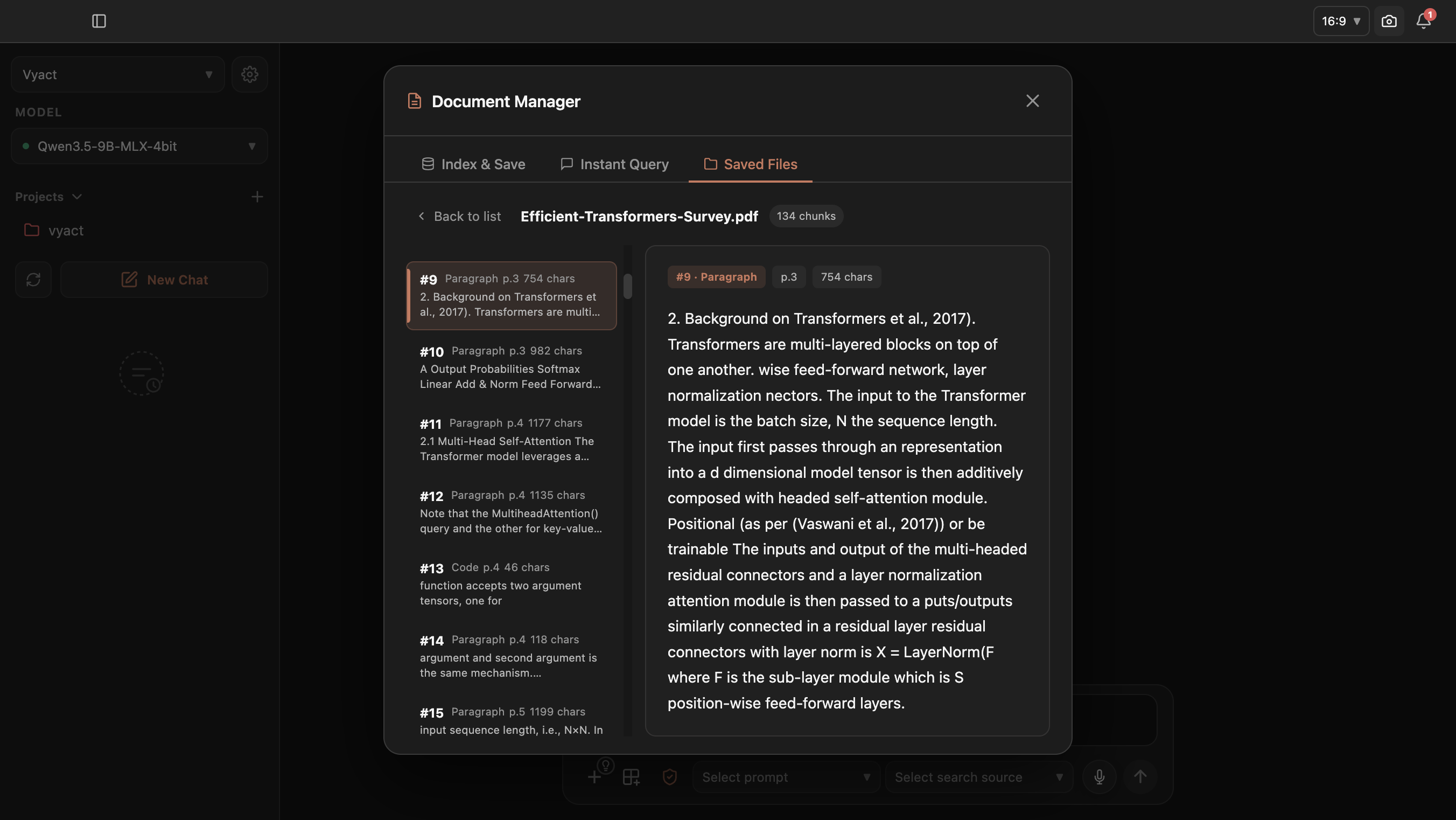
Document knowledge base and RAG:Group documents, memos and indexed email threads into knowledge collections to narrow retrieval to the task at hand, inspect the chunks that were created, and delete data you no longer want.
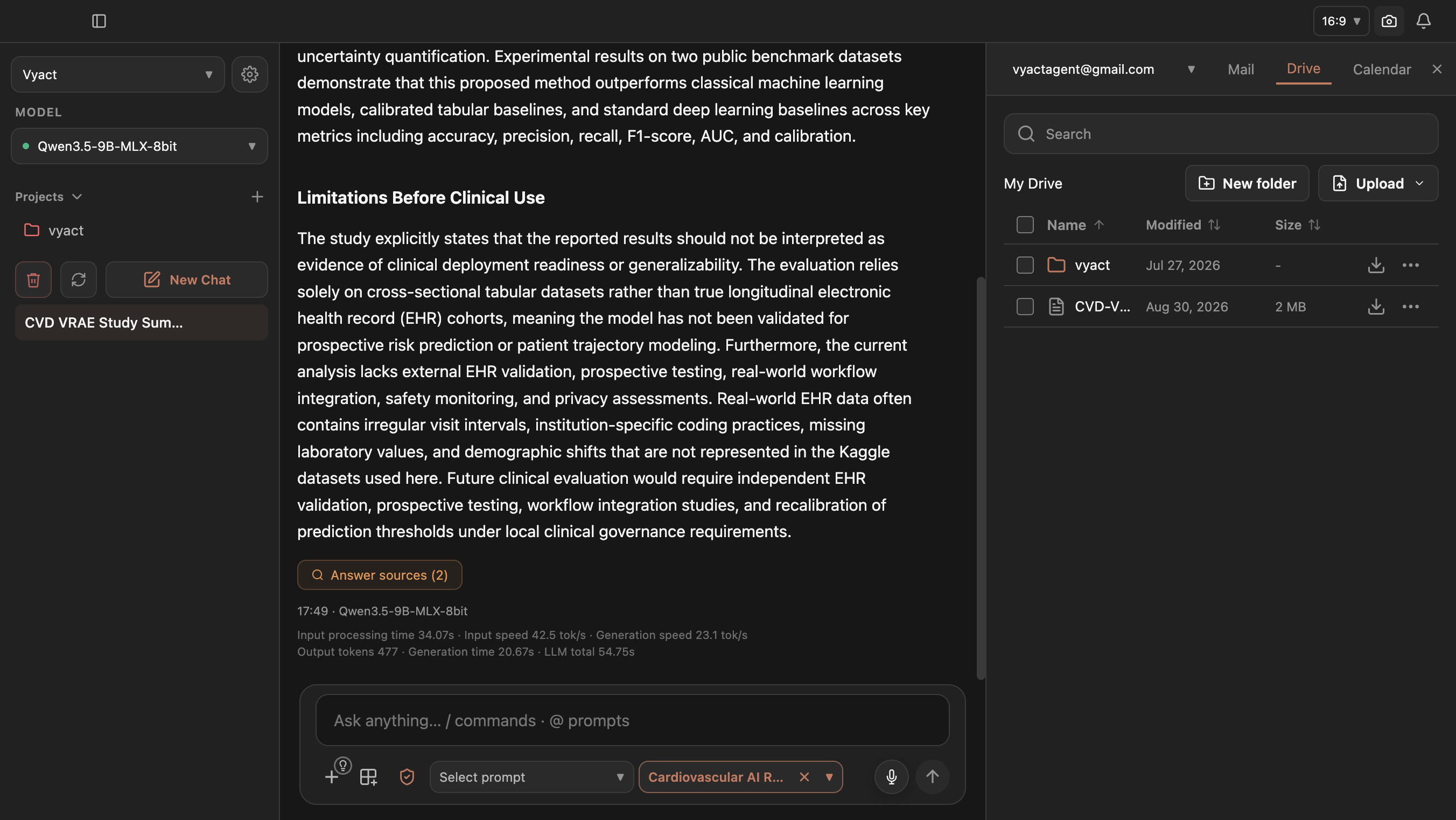
Source-aware answers:Every answer opens up to the passages and documents that informed it, so you are not left guessing whether the model invented something.
Mail and cloud integration:Connect several Google and Microsoft accounts and switch between them, pull Gmail and Outlook messages, attachments and Drive or OneDrive files into a conversation, and draft replies from that same context.
MCP tools and skills:Add filesystem access, GitHub or a custom local or remote MCP server under AI Tools, and keep reusable instructions in Skills so recurring work automatically carries the right guidance.
Local API server:Expose the active local model over an OpenAI-compatible endpoint on your network for other apps to call, with optional bearer-token authentication and copy-ready configuration and curl tests.
Open source:The source code is hosted on GitHub, so developers can study the implementation, contribute, or adapt it to their own needs.
Vyact is a local-first personal AI workspace that gathers conversations, documents, notes and everyday tools into one window. It is built around llama.cpp and MLX on Apple Silicon, so models run on your own machine and chat context need not be handed to an outside provider — though OpenAI, Gemini, Claude or any OpenAI-compatible endpoint of your own can be connected when a task calls for it. The problem it targets is the ritual of hunting down a file and re-explaining the background every time a new chat starts.
Beyond chat it carries a full document-intelligence layer: an attachment can serve a single conversation or be indexed as long-term knowledge, grouped with memos and indexed email threads into knowledge collections so RAG stays narrowed to the material that matters, and every answer traces back to the passages behind it. Gmail, Outlook, Google Drive, OneDrive and calendars plug straight into the conversation, while a Chrome extension covers translation, rewriting and dual-subtitle study on Netflix. The desktop app is built on Electron with installers for macOS, Windows and Linux, released under AGPL-3.0, with an interface available in eight languages including Chinese.
Features
Local model management:Search and compare GGUF and MLX models in-app, weighing model size, quantization, context capacity and hardware-aware memory estimates against detected RAM and VRAM before downloading, after which Vyact installs the model and its matching runtime.
Settings benchmarks:The performance test in model settings runs each candidate configuration through a short input, a long input and a follow-up, comparing time to first token, generation speed, total response time and reused prefix tokens, with the winning combination applied in one click.
Document knowledge base and RAG:Group documents, memos and indexed email threads into knowledge collections to narrow retrieval to the task at hand, inspect the chunks that were created, and delete data you no longer want.
Source-aware answers:Every answer opens up to the passages and documents that informed it, so you are not left guessing whether the model invented something.
Mail and cloud integration:Connect several Google and Microsoft accounts and switch between them, pull Gmail and Outlook messages, attachments and Drive or OneDrive files into a conversation, and draft replies from that same context.
MCP tools and skills:Add filesystem access, GitHub or a custom local or remote MCP server under AI Tools, and keep reusable instructions in Skills so recurring work automatically carries the right guidance.
Local API server:Expose the active local model over an OpenAI-compatible endpoint on your network for other apps to call, with optional bearer-token authentication and copy-ready configuration and curl tests.
Open source:The source code is hosted on GitHub, so developers can study the implementation, contribute, or adapt it to their own needs.