Description
< #Infinite Canvas #Context Engineering #Knowledge Graph #AI Chat #MCP #Local First #Open Source
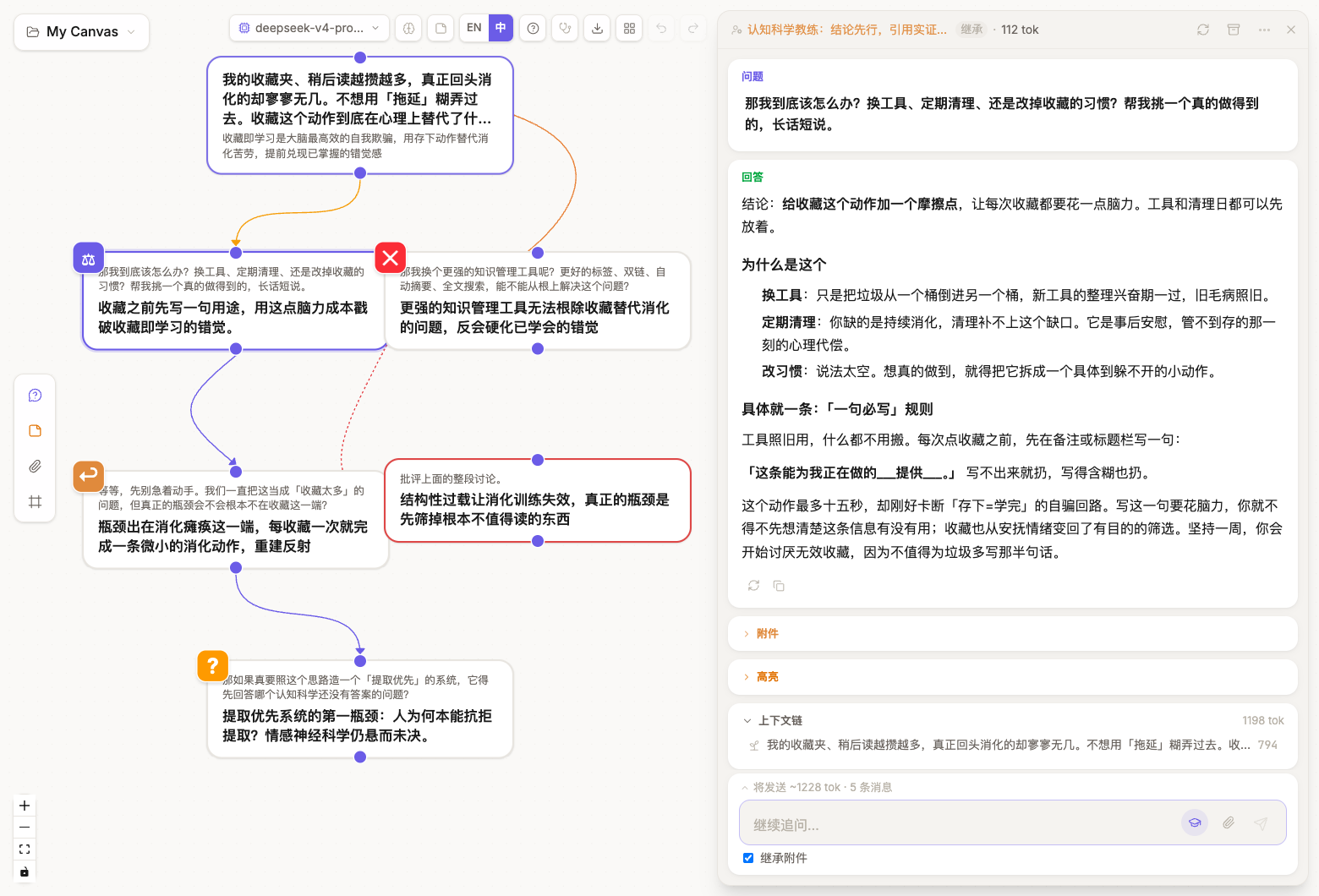
ThoughtDAG is an infinite canvas that grows LLM conversations into an editable thought graph. It runs on a single rule: the wires are the context — what the model sees is exactly what wires into the node. Delete one edge and the same question comes back with a different answer; editing the graph edits the model’s memory.
Plenty of tools put conversations on a canvas, but there the edges usually organize ideas for people, or route a task through a workflow. Here an edge decides what the next request carries, while the branches you excluded stay visible on the canvas. The human stays in the loop throughout — no autonomous agent redraws your graph. It is MIT licensed, ships desktop builds for macOS, Windows and Linux, and can also be run from source or tried in the browser demo first.
Wires decide the context: Incoming paths and explicit references compose the next request, so cutting an edge, pruning a branch or merging several paths immediately changes the model input — the excluded work is not deleted, it just stops joining the conversation.
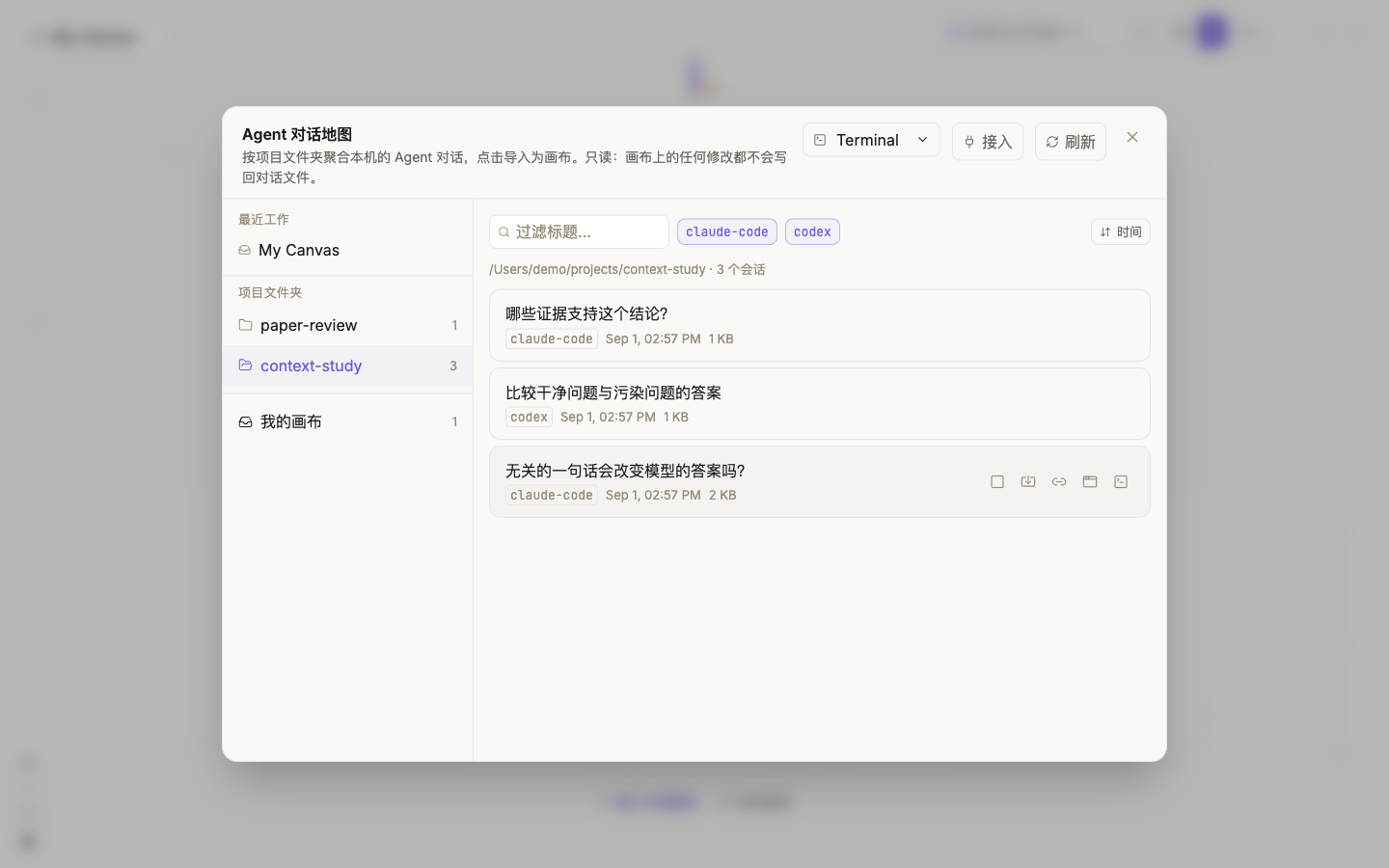
Session Atlas: Sessions scattered across local Claude Code, Codex, DeepSeek Harness and Pi are pulled into one context graph. Source sessions stay read-only, you can continue from any node, and the new work returns to where the thought began.
Search history across agents: From the command line,
Read a paper into a map: Select a passage in the built-in PDF and file reader and ask right there. The answer lands on the canvas carrying its page number, and the page chip jumps back to the source — finish the paper and the map is already drawn.
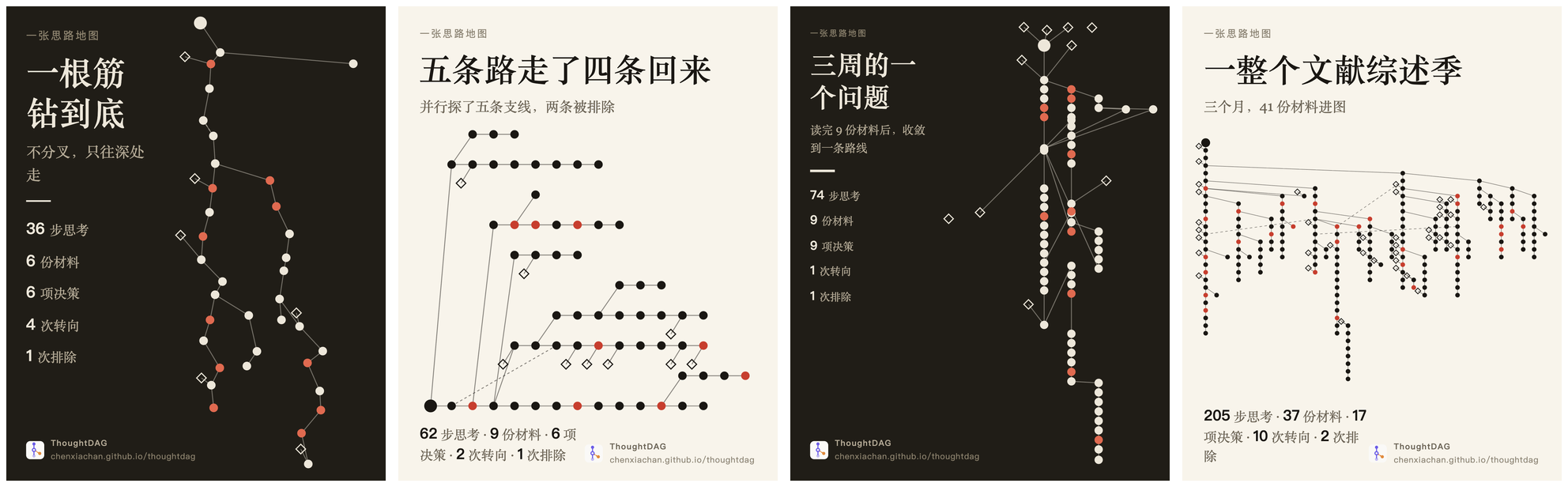
Condense and zoom: Merge nodes into a higher-level conclusion and zoom between full cards, takeaway plaques and an icon skeleton, then export the current structure as a light or dark Thought Map.
Staleness and replay: When an upstream node changes, the answers it invalidates are marked, and they can be replayed in dependency order with a token estimate shown first.
Any model: Works with OpenAI-compatible endpoints and local models, pins a model per node, and lets text-only models read images through their companion text.
Local-first and sharing: Automatic backup writes real files, so pointing it at a synced folder covers several devices; a read-only share link carries the whole graph with no account and nothing stored on a server.
Open source project: The source code is hosted on GitHub, so developers can study the implementation, contribute, or customize it for their own needs.
ThoughtDAG is an infinite canvas that grows LLM conversations into an editable thought graph. It runs on a single rule: the wires are the context — what the model sees is exactly what wires into the node. Delete one edge and the same question comes back with a different answer; editing the graph edits the model’s memory.
Plenty of tools put conversations on a canvas, but there the edges usually organize ideas for people, or route a task through a workflow. Here an edge decides what the next request carries, while the branches you excluded stay visible on the canvas. The human stays in the loop throughout — no autonomous agent redraws your graph. It is MIT licensed, ships desktop builds for macOS, Windows and Linux, and can also be run from source or tried in the browser demo first.
Features
Wires decide the context: Incoming paths and explicit references compose the next request, so cutting an edge, pruning a branch or merging several paths immediately changes the model input — the excluded work is not deleted, it just stops joining the conversation.
Session Atlas: Sessions scattered across local Claude Code, Codex, DeepSeek Harness and Pi are pulled into one context graph. Source sessions stay read-only, you can continue from any node, and the new work returns to where the thought began.
Search history across agents: From the command line,
npx thoughtdag why src/lib/api.ts lists the conversations that touched or mentioned a file and find traces a phrase back to the exact turn. Installed globally, it also exposes read-only MCP tools so your agent can run those queries itself.Read a paper into a map: Select a passage in the built-in PDF and file reader and ask right there. The answer lands on the canvas carrying its page number, and the page chip jumps back to the source — finish the paper and the map is already drawn.
Condense and zoom: Merge nodes into a higher-level conclusion and zoom between full cards, takeaway plaques and an icon skeleton, then export the current structure as a light or dark Thought Map.
Staleness and replay: When an upstream node changes, the answers it invalidates are marked, and they can be replayed in dependency order with a token estimate shown first.
Any model: Works with OpenAI-compatible endpoints and local models, pins a model per node, and lets text-only models read images through their companion text.
Local-first and sharing: Automatic backup writes real files, so pointing it at a synced folder covers several devices; a read-only share link carries the whole graph with no account and nothing stored on a server.
Open source project: The source code is hosted on GitHub, so developers can study the implementation, contribute, or customize it for their own needs.