Description
#Visual RAG #Web Crawler #Multimodal AI #ClaudeCode #Qwen3VL #FAISS
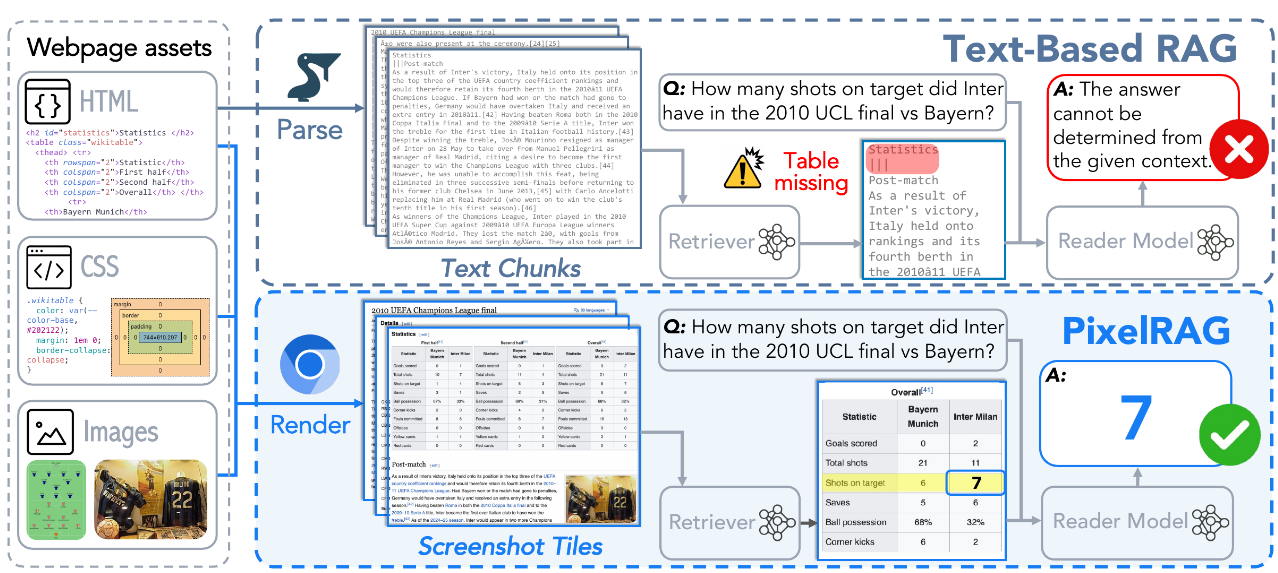
PixelRAG is an open-source RAG tool based on visual retrieval. It does not rely on traditional HTML parsing but instead renders web pages, PDFs, papers, or local applications into screenshots, allowing visual models to directly retrieve and understand content from pixels.
Traditional web parsing often loses tables, charts, formulas, formatting, and page structure. PixelRAG directly indexes the pages users actually see, preserving more visual information and reducing content loss during the parsing process. The project introduction states that its team has built a visual index containing over 30 million Wikipedia screenshots, achieving an 18.1% higher performance in pure text question-answering tasks compared to strong text RAG benchmarks.
- Preserves visual information: The relationships between tables, charts, formulas, layout, and text can all be retained.
- Supports various content sources: Can handle regular web pages, PDFs, arXiv papers, and local application interfaces.
- Visual RAG process: Renders pages as image blocks, then generates visual vectors and stores them in the retrieval index.
- Qwen3-VL-Embedding: Uses a visual embedding model to process screenshots and enhances retrieval performance through LoRA fine-tuned for screenshot data.
- FAISS vector index: Stores generated visual vectors in FAISS for quick searches of related pages.
- Claude Code plugin: Provides visual browsing capabilities for Claude, enabling it to take screenshots of pages and answer questions based on rendering results.
- No need to re-parse pages due to visual model upgrades: Original page screenshots can be retained, allowing continued use of existing visual data after model upgrades.
- Reduces parser impact: Bypasses HTML cleaning, body extraction, and structural conversion, which are prone to information loss.
- Completely open source: Project code is publicly available for research, deployment, and secondary development.
PixelRAG is an open-source RAG tool based on visual retrieval. It does not rely on traditional HTML parsing but instead renders web pages, PDFs, papers, or local applications into screenshots, allowing visual models to directly retrieve and understand content from pixels.
Traditional web parsing often loses tables, charts, formulas, formatting, and page structure. PixelRAG directly indexes the pages users actually see, preserving more visual information and reducing content loss during the parsing process. The project introduction states that its team has built a visual index containing over 30 million Wikipedia screenshots, achieving an 18.1% higher performance in pure text question-answering tasks compared to strong text RAG benchmarks.
Software Features
- Pixel-based web retrieval: Indexes rendered page screenshots directly without converting web pages to plain text first.- Preserves visual information: The relationships between tables, charts, formulas, layout, and text can all be retained.
- Supports various content sources: Can handle regular web pages, PDFs, arXiv papers, and local application interfaces.
- Visual RAG process: Renders pages as image blocks, then generates visual vectors and stores them in the retrieval index.
- Qwen3-VL-Embedding: Uses a visual embedding model to process screenshots and enhances retrieval performance through LoRA fine-tuned for screenshot data.
- FAISS vector index: Stores generated visual vectors in FAISS for quick searches of related pages.
- Claude Code plugin: Provides visual browsing capabilities for Claude, enabling it to take screenshots of pages and answer questions based on rendering results.
- No need to re-parse pages due to visual model upgrades: Original page screenshots can be retained, allowing continued use of existing visual data after model upgrades.
- Reduces parser impact: Bypasses HTML cleaning, body extraction, and structural conversion, which are prone to information loss.
- Completely open source: Project code is publicly available for research, deployment, and secondary development.