Description
Asking an AI which files are eating your B2 storage, or where last month's egress went, still ends with you opening the console to read reports or writing an S3 script and pasting the output back into the chat. That shuttling costs more time than the question did.
b2-mcp is Backblaze's own MCP server, attaching B2 to any MCP-compatible AI client — install it and ask in plain language for buckets, files and keys to be operated on, with no SDK calls to write yourself. A few lines in the Claude Desktop config and it runs.
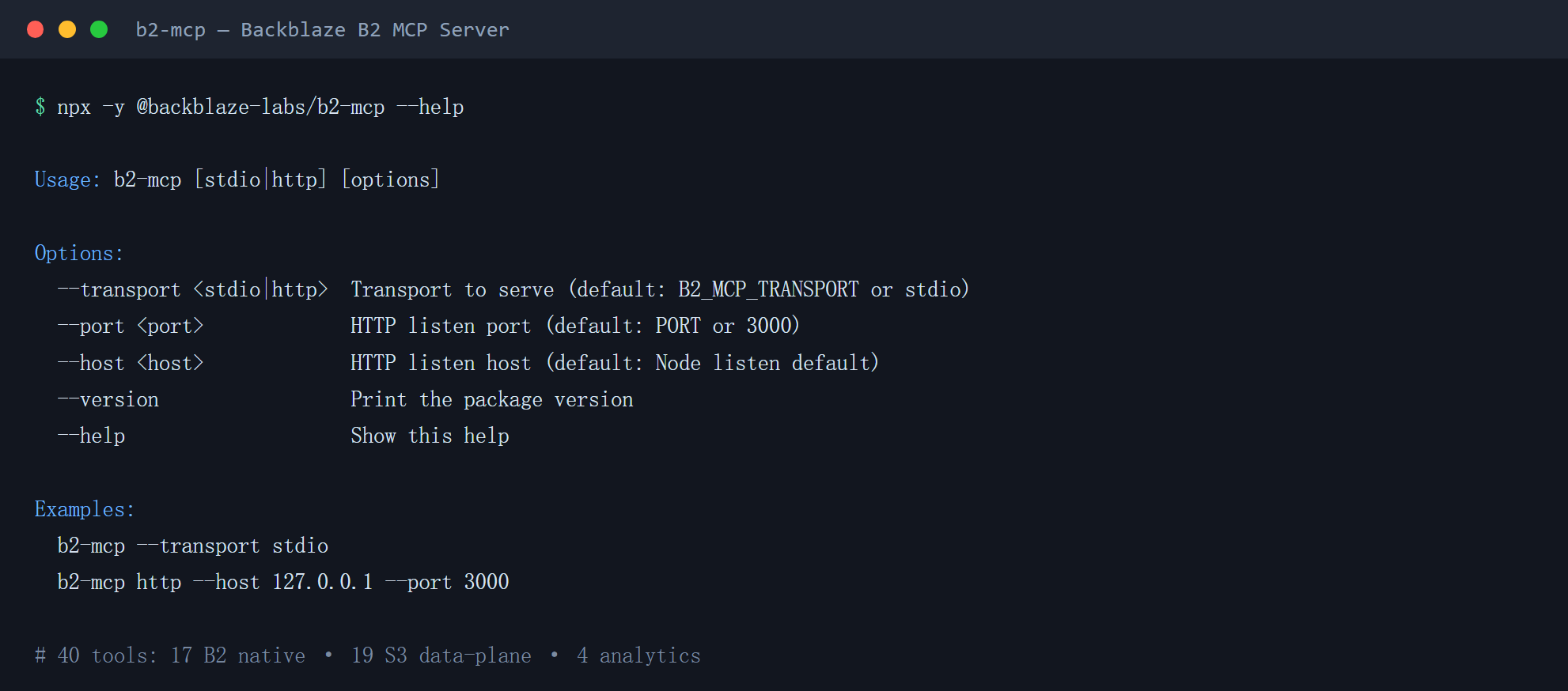
Forty tools in three groups: 17 on the native B2 SDK (buckets, application keys, Object Lock, event notifications — control-plane work the S3 API has no equivalent for), 19 on the AWS S3 SDK (upload, download, copy, multipart, lifecycle, presigned URLs), and 4 written for the server itself. Open-source under MIT.
Destructive actions are gated: irreversible operations like deletion are held behind a gate, so a misread instruction cannot empty a bucket, and self-hosting lets you tighten the permissions further.
Secrets stay out of the model's context: in the default mode durable B2 credentials are never pushed into the conversation, staying on the server side — which matters when you are experimenting against a production bucket.
Capability-aware registration: start it with a restricted application key and it only exposes the tools that key can actually use, rather than letting the AI call an endpoint destined to return 403. A non-master key covers everyday work.
Four ready-made analytics: storage growth, egress leaders, largest files and abandoned multipart uploads — the questions people actually ask — without assembling a report yourself.
Two transports: stdio by default for a local client to connect directly, or an HTTP server on a chosen port to sit on your own machine and serve several clients.
Read-only resources: server config, the current key's capabilities and per-bucket details are exposed as read-only resources, so the assistant can survey the environment before touching anything.
b2-mcp is Backblaze's own MCP server, attaching B2 to any MCP-compatible AI client — install it and ask in plain language for buckets, files and keys to be operated on, with no SDK calls to write yourself. A few lines in the Claude Desktop config and it runs.
Forty tools in three groups: 17 on the native B2 SDK (buckets, application keys, Object Lock, event notifications — control-plane work the S3 API has no equivalent for), 19 on the AWS S3 SDK (upload, download, copy, multipart, lifecycle, presigned URLs), and 4 written for the server itself. Open-source under MIT.
Features
Destructive actions are gated: irreversible operations like deletion are held behind a gate, so a misread instruction cannot empty a bucket, and self-hosting lets you tighten the permissions further.
Secrets stay out of the model's context: in the default mode durable B2 credentials are never pushed into the conversation, staying on the server side — which matters when you are experimenting against a production bucket.
Capability-aware registration: start it with a restricted application key and it only exposes the tools that key can actually use, rather than letting the AI call an endpoint destined to return 403. A non-master key covers everyday work.
Four ready-made analytics: storage growth, egress leaders, largest files and abandoned multipart uploads — the questions people actually ask — without assembling a report yourself.
Two transports: stdio by default for a local client to connect directly, or an HTTP server on a chosen port to sit on your own machine and serve several clients.
Read-only resources: server config, the current key's capabilities and per-bucket details are exposed as read-only resources, so the assistant can survey the environment before touching anything.