Description
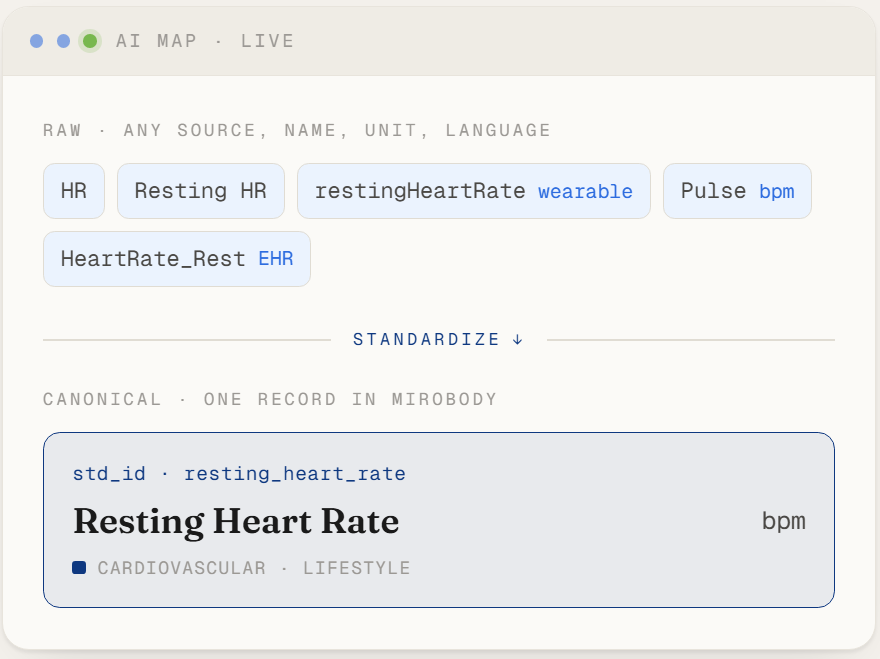
Handing your check-up results and smartwatch data to an AI stalls at step one: one hospital writes "fasting glucose", another writes "GLU-F", the wearable exports it as bloodGlucose, and the units are mg/dL on one side and mmol/L on the other. Together the data reads like five languages the AI cannot parse, and fixing it by hand in a spreadsheet never ends.
Mirobody does that translation: whatever the source, spelling, unit or language, everything lands on one standard code. "血红蛋白", "ヘモグロビン" and "hemoglobin" all resolve to LOINC 718-7. Lab reports, wearables and imaging go in; one record an AI can read comes out.
Open-source and free, installable as a Python package, and the resolver runs entirely offline — health data never has to be sent to anyone.
Cross-language matching: indicator names in Chinese, Japanese and English map to the same code even when mixed together, so reports do not need translating before they go in.
Units decide the code: the same name with different units is genuinely a different measurement — total cholesterol in mg/dL and in mmol/L resolve to two distinct codes. Pass the value and the unit and it codes by actual meaning rather than by name alone.
It abstains rather than guessing: given a vague category like "lipids" it returns unresolved instead of forcing a plausible-looking code. A visible gap you can investigate beats a confident wrong answer.
Runs offline: the resolver needs no network, so check-up data stays on the machine it was installed on.
Standards-based output: codes follow LOINC, units are normalized through UCUM, and results are shaped for FHIR, giving a common format for existing clinical systems and for feeding a model.
Built for AI to call: a Python library and MCP integration let an assistant invoke it to make sense of a report directly, instead of you writing a pile of parsing rules.
Mirobody does that translation: whatever the source, spelling, unit or language, everything lands on one standard code. "血红蛋白", "ヘモグロビン" and "hemoglobin" all resolve to LOINC 718-7. Lab reports, wearables and imaging go in; one record an AI can read comes out.
Open-source and free, installable as a Python package, and the resolver runs entirely offline — health data never has to be sent to anyone.
Features
Cross-language matching: indicator names in Chinese, Japanese and English map to the same code even when mixed together, so reports do not need translating before they go in.
Units decide the code: the same name with different units is genuinely a different measurement — total cholesterol in mg/dL and in mmol/L resolve to two distinct codes. Pass the value and the unit and it codes by actual meaning rather than by name alone.
It abstains rather than guessing: given a vague category like "lipids" it returns unresolved instead of forcing a plausible-looking code. A visible gap you can investigate beats a confident wrong answer.
Runs offline: the resolver needs no network, so check-up data stays on the machine it was installed on.
Standards-based output: codes follow LOINC, units are normalized through UCUM, and results are shaped for FHIR, giving a common format for existing clinical systems and for feeding a model.
Built for AI to call: a Python library and MCP integration let an assistant invoke it to make sense of a report directly, instead of you writing a pile of parsing rules.