Description
Most world-model demos of the past year followed the same script: feed in one image, get back a fifteen-second clip. Impressive to watch, but you cannot touch it, and after a while the picture smears and the scene drifts. Far more watching than playing.
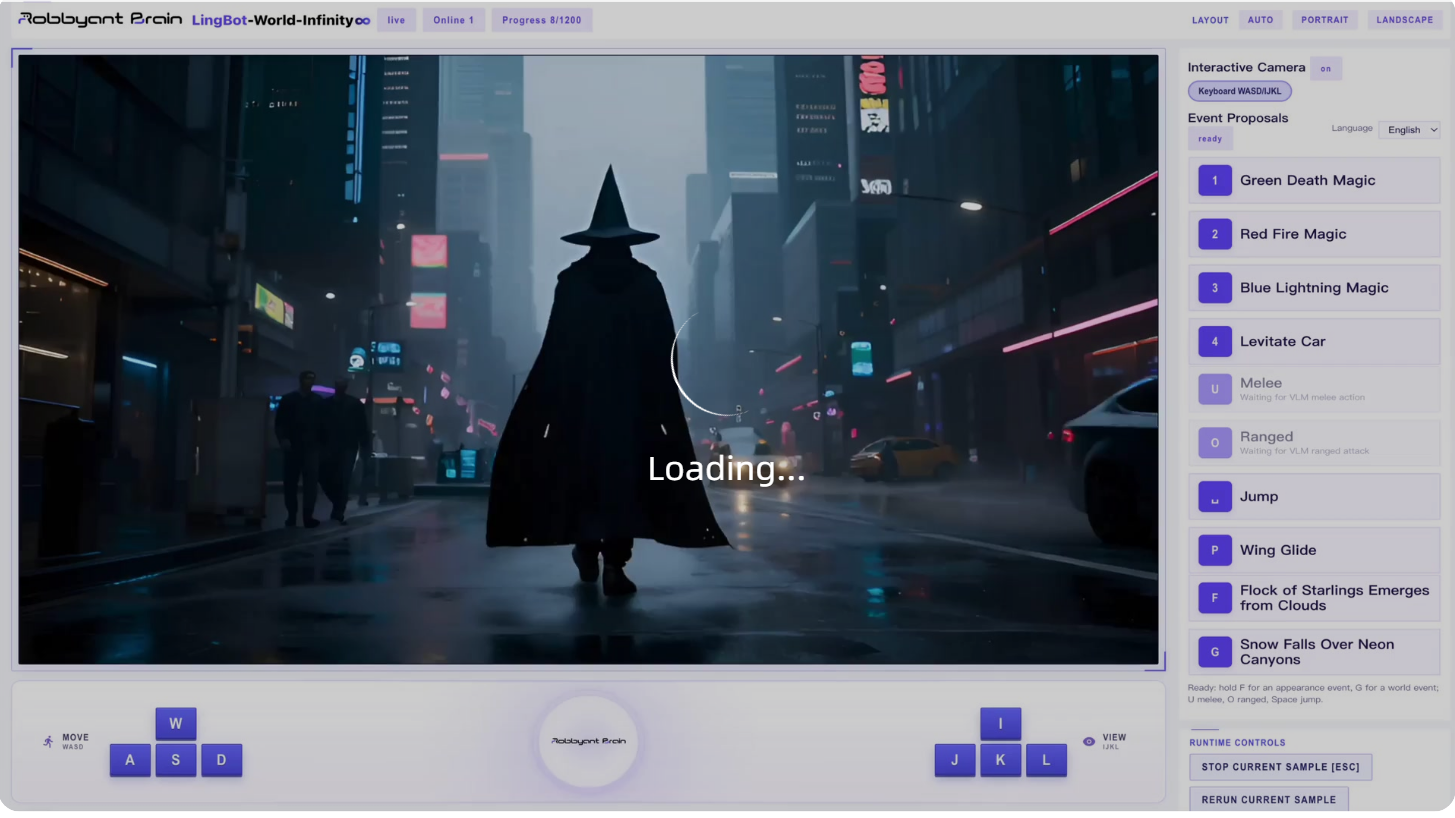
LingBot-World 2.0 (LingBot-World-Infinity in the paper) moves that along: hand it an image and what comes back is a world you can actually drive in real time. WASD to move, IJKL to look, Space to jump, U for melee, O for ranged, P to glide, and number keys to fire off spells. That is literally the demo on the project page — a wizard on a cyberpunk street, with "Green Death Magic", "Red Fire Magic" and "Levitate Car" sitting in a panel waiting for a keypress.
Two architectural pieces are worth calling out. First, a causal pretraining paradigm that makes the interaction horizon unbounded while output quality stays consistent — the world does not fall apart the longer you play — with a distilled real-time variant fast enough to drive a 720p 60fps stream. Second, an agentic harness: a pilot agent plans and executes character behaviour while a director agent synthesises new environmental elements as the scene progresses, so the world keeps growing without constant prompting. Events are not just actions either — "Snow Falls Over Neon Canyons" changes the weather and the scene.
The code, technical report and the 14B causal-fast weights are all out, on both HuggingFace and ModelScope; the 1.3B model and two other 14B variants are still on the TODO list. It is built on Wan2.2.
Image to world: one image plus a scene description produces an environment you can enter; the published example runs the i2v-A14B task driven by an action-sequence file.
Real-time control: the distilled real-time variant sustains 720p at 60fps, with WASD for movement, IJKL for the camera and Space to jump.
A wider action set: melee, archery, spell-casting and shooting were added over the previous version, with a VLM resolving the action before it lands in frame.
Text-driven events: trigger environmental change by text, from a local appearance like "a flock of starlings emerges from the clouds" to a whole-scene weather shift.
Two agents driving evolution: the pilot agent plans and executes character behaviour; the director agent adds new environmental elements as the scene moves on, so the world develops on its own.
Unbounded interaction horizon: the causal pretraining paradigm keeps quality consistent no matter how long you keep going — the headline change from version one.
Try it online: Reactor hosts the international web demo and LingGuang the domestic mobile one; the full-capability official demo is at WAIC 2026.
What running it yourself takes: the published inference example is 480P across eight GPUs via torchrun, needing torch 2.4+ and flash-attn. The authors state plainly that the deployment code will not be released — self-hosting means following the SGLang or NVIDIA flashdreams recipes.
Read the licence: CC BY-NC-SA 4.0 — share and adapt with attribution, derivatives under the same terms, and no commercial use.
LingBot-World 2.0 (LingBot-World-Infinity in the paper) moves that along: hand it an image and what comes back is a world you can actually drive in real time. WASD to move, IJKL to look, Space to jump, U for melee, O for ranged, P to glide, and number keys to fire off spells. That is literally the demo on the project page — a wizard on a cyberpunk street, with "Green Death Magic", "Red Fire Magic" and "Levitate Car" sitting in a panel waiting for a keypress.
Two architectural pieces are worth calling out. First, a causal pretraining paradigm that makes the interaction horizon unbounded while output quality stays consistent — the world does not fall apart the longer you play — with a distilled real-time variant fast enough to drive a 720p 60fps stream. Second, an agentic harness: a pilot agent plans and executes character behaviour while a director agent synthesises new environmental elements as the scene progresses, so the world keeps growing without constant prompting. Events are not just actions either — "Snow Falls Over Neon Canyons" changes the weather and the scene.
The code, technical report and the 14B causal-fast weights are all out, on both HuggingFace and ModelScope; the 1.3B model and two other 14B variants are still on the TODO list. It is built on Wan2.2.
Features
Image to world: one image plus a scene description produces an environment you can enter; the published example runs the i2v-A14B task driven by an action-sequence file.
Real-time control: the distilled real-time variant sustains 720p at 60fps, with WASD for movement, IJKL for the camera and Space to jump.
A wider action set: melee, archery, spell-casting and shooting were added over the previous version, with a VLM resolving the action before it lands in frame.
Text-driven events: trigger environmental change by text, from a local appearance like "a flock of starlings emerges from the clouds" to a whole-scene weather shift.
Two agents driving evolution: the pilot agent plans and executes character behaviour; the director agent adds new environmental elements as the scene moves on, so the world develops on its own.
Unbounded interaction horizon: the causal pretraining paradigm keeps quality consistent no matter how long you keep going — the headline change from version one.
Try it online: Reactor hosts the international web demo and LingGuang the domestic mobile one; the full-capability official demo is at WAIC 2026.
What running it yourself takes: the published inference example is 480P across eight GPUs via torchrun, needing torch 2.4+ and flash-attn. The authors state plainly that the deployment code will not be released — self-hosting means following the SGLang or NVIDIA flashdreams recipes.
Read the licence: CC BY-NC-SA 4.0 — share and adapt with attribution, derivatives under the same terms, and no commercial use.