Description
Nobody working with materials escapes this step: an XRD pattern comes in and you need phase identification, quantities, crystallite size and strain, ideally texture too — commercial packages cost a suite each, and the free ones each handle one piece.
MAUD (Materials Analysis Using Diffraction) does it inside one Rietveld refinement: fit the entire pattern with a single unified model and get phase content, crystal structures, microstructure (size and strain), crystallographic texture and planar defects at once. It takes X-ray, neutron and electron data, and handles reflectivity and fluorescence spectra as well as diffraction. Amorphous and nanomaterials are in scope.
Written in Java with the runtime bundled, on Windows, macOS and Linux. Free to use, source on GitHub, written by Luca Lutterotti.
Rietveld refinement: whole-pattern fitting that returns phase fractions, cell parameters and atomic positions in one run.
Microstructure: crystallite size and microstrain with optional anisotropic models.
Texture and residual stress: quantitative texture (ODF) and residual stress from multiple patterns at different orientations.
Many data sources: X-ray, neutron, TOF, TEM electron diffraction, plus reflectivity and fluorescence.
Bundled examples: sample datasets and tutorials ship with it, so you can run through one before loading your own data.
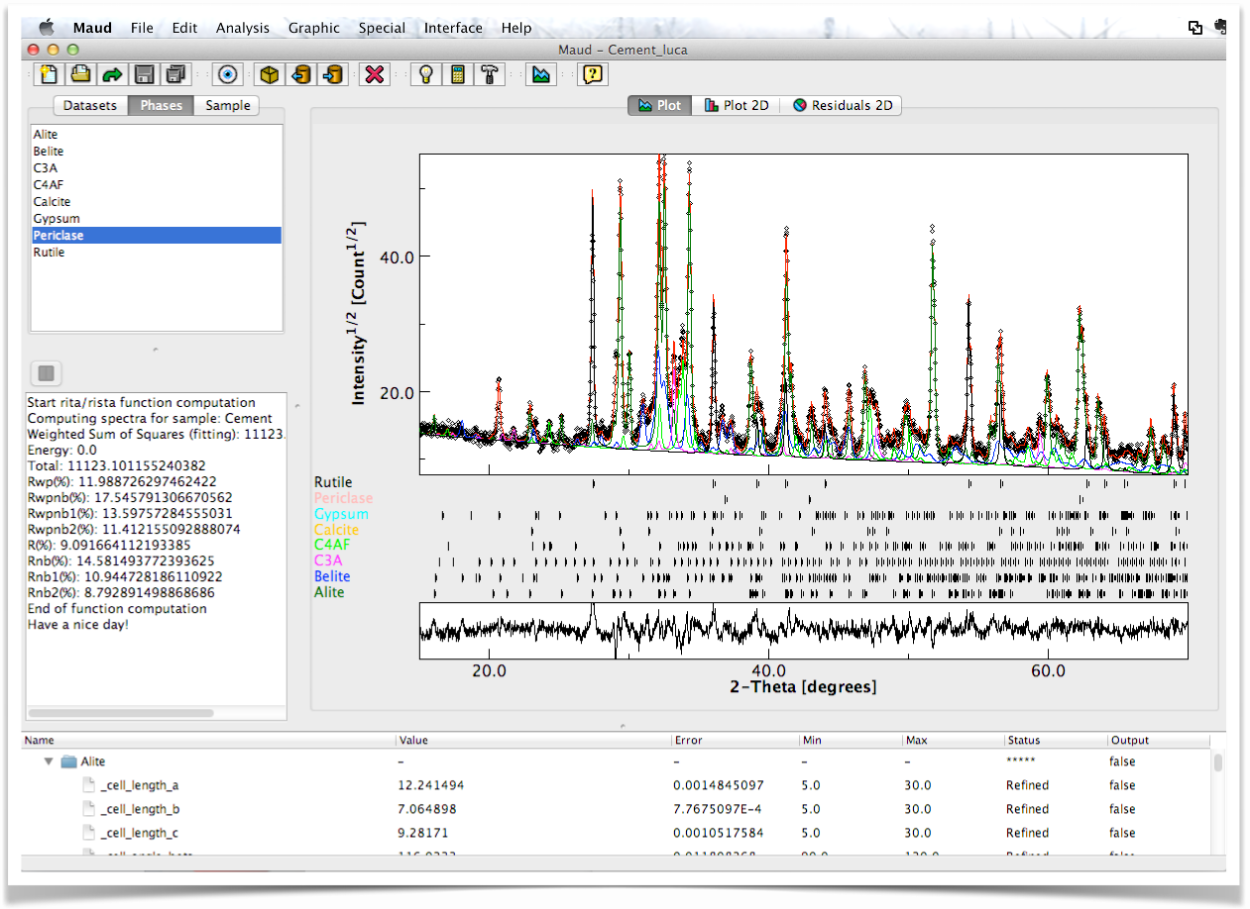
Visualisation: fit, residuals, 2D plots and per-phase peak positions side by side in one window.
MAUD (Materials Analysis Using Diffraction) does it inside one Rietveld refinement: fit the entire pattern with a single unified model and get phase content, crystal structures, microstructure (size and strain), crystallographic texture and planar defects at once. It takes X-ray, neutron and electron data, and handles reflectivity and fluorescence spectra as well as diffraction. Amorphous and nanomaterials are in scope.
Written in Java with the runtime bundled, on Windows, macOS and Linux. Free to use, source on GitHub, written by Luca Lutterotti.
Features
Rietveld refinement: whole-pattern fitting that returns phase fractions, cell parameters and atomic positions in one run.
Microstructure: crystallite size and microstrain with optional anisotropic models.
Texture and residual stress: quantitative texture (ODF) and residual stress from multiple patterns at different orientations.
Many data sources: X-ray, neutron, TOF, TEM electron diffraction, plus reflectivity and fluorescence.
Bundled examples: sample datasets and tutorials ship with it, so you can run through one before loading your own data.
Visualisation: fit, residuals, 2D plots and per-phase peak positions side by side in one window.
Screenshots
Tags:crystallography