Description
Reading an unfamiliar paper always costs the same set of moves: search for it, download the PDF, skim the abstract to decide whether it deserves real attention, and — if you actually want to trust the result — dig through its public repo line by line to see whether the code does what the paper claims. One paper eats half a day. Ten of them is hopeless.
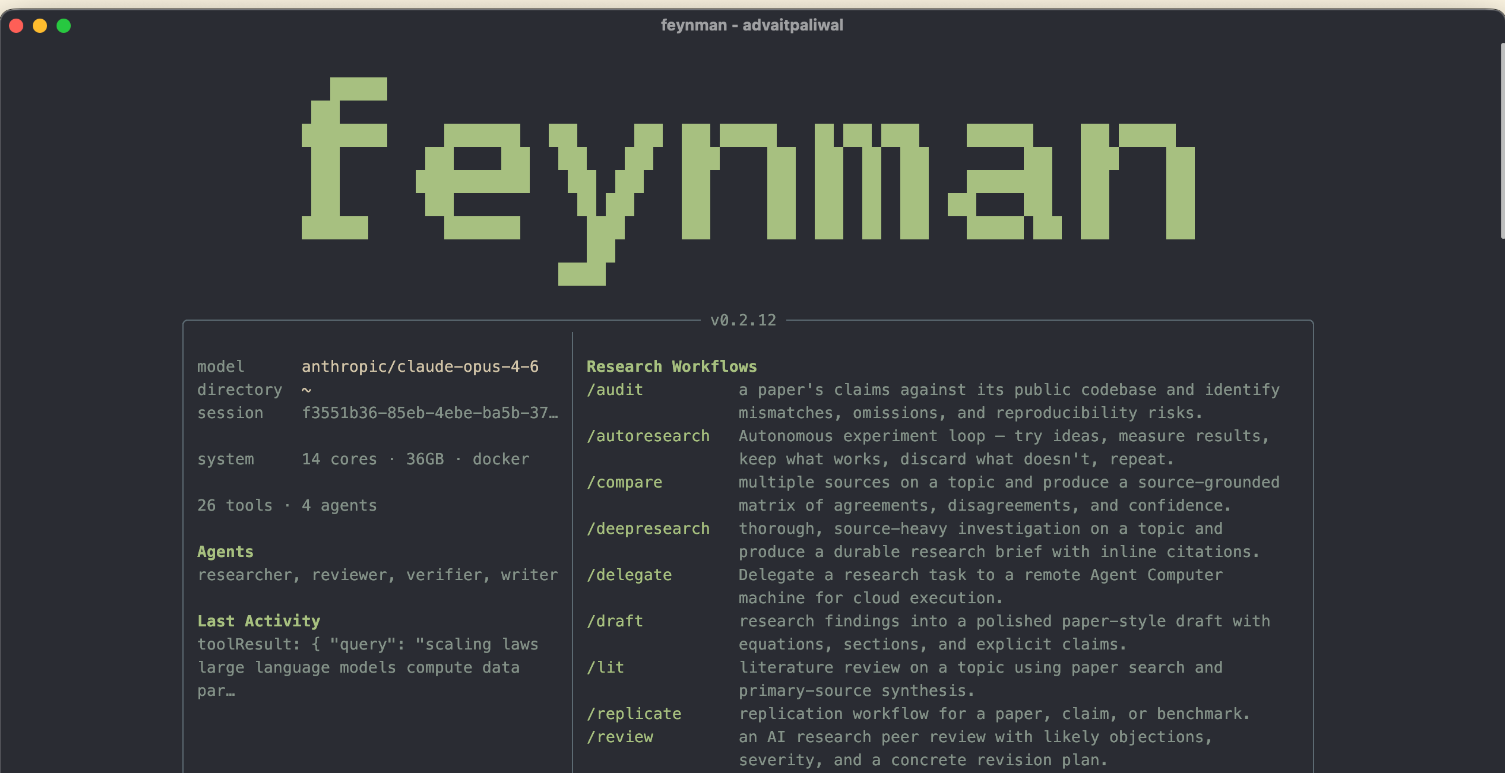
Feynman turns that whole routine into terminal commands. feynman rank scores a pile of papers on citations, method, reproducibility and provenance, with the evidence shown for each, so you know what to read first. feynman audit puts a paper next to its public codebase and reports exactly which claims are unimplemented, what was quietly omitted, and where reproduction is likely to break.
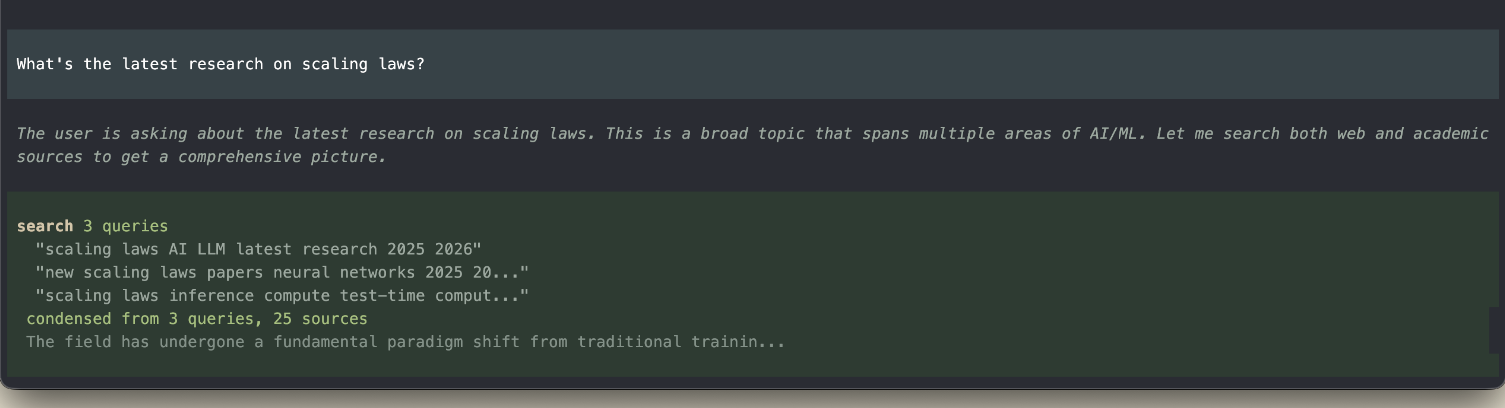
Four agents split the work inside: Researcher gathers evidence across papers, the web, repos and docs; Reviewer critiques it internally with severity grades; Writer turns notes into structured drafts; Verifier checks inline citations and source URLs and strips dead links. Every research claim comes back with a link you can open.
Paper ranking:
Paper vs. code audit:
Multi-agent deep research:
Literature review:
Replication planning:
Local science workbench:
A long list of open data sources: OpenAlex, PubMed, Europe PMC, ClinicalTrials.gov, UniProt, DepMap, ChEMBL and GWAS Catalog are queryable directly, and Hugging Face dataset metadata and schemas can be inspected too. Paper search and code reading run through alphaXiv.
Bring your own model: sign in to a hosted provider once with
One-line install on all three platforms: a curl script on macOS and Linux, a single PowerShell line on Windows. The installer ships a standalone bundle with its own pinned Node runtime and verifies the release SHA-256 before replacing an existing install; npm global install works too.
Feynman turns that whole routine into terminal commands. feynman rank scores a pile of papers on citations, method, reproducibility and provenance, with the evidence shown for each, so you know what to read first. feynman audit puts a paper next to its public codebase and reports exactly which claims are unimplemented, what was quietly omitted, and where reproduction is likely to break.
Four agents split the work inside: Researcher gathers evidence across papers, the web, repos and docs; Reviewer critiques it internally with severity grades; Writer turns notes into structured drafts; Verifier checks inline citations and source URLs and strips dead links. Every research claim comes back with a link you can open.
Features
Paper ranking:
feynman rank <topic> uses PaperRank scoring to decide what to read first. --expand-citations pulls cited and citing papers into a local citation graph before scoring prestige; --full-text-top adds section-aware full-text evidence and rescores.Paper vs. code audit:
feynman audit 2401.12345 takes an arXiv id, finds the matching repository, and walks the paper’s claims against the implementation, reporting mismatches, omissions and reproducibility risks.Multi-agent deep research:
feynman deepresearch runs parallel researchers, synthesises their findings and then verifies them, producing a brief with inline citations rather than an unsourced summary.Literature review:
feynman lit separates consensus, disagreements and open questions. Give it a lab or PI name instead of a topic and it maps that group’s publication trajectory.Replication planning:
feynman replicate plans the checks first and only executes them after you explicitly pick an environment — nothing runs on your machine by surprise.Local science workbench:
feynman serve opens a standalone local app with projects, sessions, notebooks, compute, artifact previews and provenance. Reports, spreadsheets, PDFs, audio and video, Jupyter notebooks, LaTeX and chemistry structures are all viewable in place.A long list of open data sources: OpenAlex, PubMed, Europe PMC, ClinicalTrials.gov, UniProt, DepMap, ChEMBL and GWAS Catalog are queryable directly, and Hugging Face dataset metadata and schemas can be inspected too. Paper search and code reading run through alphaXiv.
Bring your own model: sign in to a hosted provider once with
feynman model login, or point it at LM Studio, LiteLLM, Ollama or vLLM through feynman setup for a fully local stack.One-line install on all three platforms: a curl script on macOS and Linux, a single PowerShell line on Windows. The installer ships a standalone bundle with its own pinned Node runtime and verifies the release SHA-256 before replacing an existing install; npm global install works too.