Description
Getting an AI to work on a repository it has never seen costs more explaining than coding: which stack, how the directories are split, which module depends on which, why a particular convention exists. Move to another repository and the whole explanation starts over.
OpenWiki’s answer is to write that explanation down once as a wiki. It is a command line tool that has an agent read through your codebase and produce a set of linked Markdown pages meant to be read by coding agents as a manual for the project. The files land in your repository — your own Markdown, not something parked on someone else’s server.
This is not the same thing as conventional project documentation. Conventional docs are written for people and start going stale immediately; OpenWiki is written for agents to read and can be wired into GitHub Actions, GitLab CI or Bitbucket Pipelines to run on a schedule, so the pages follow the code.
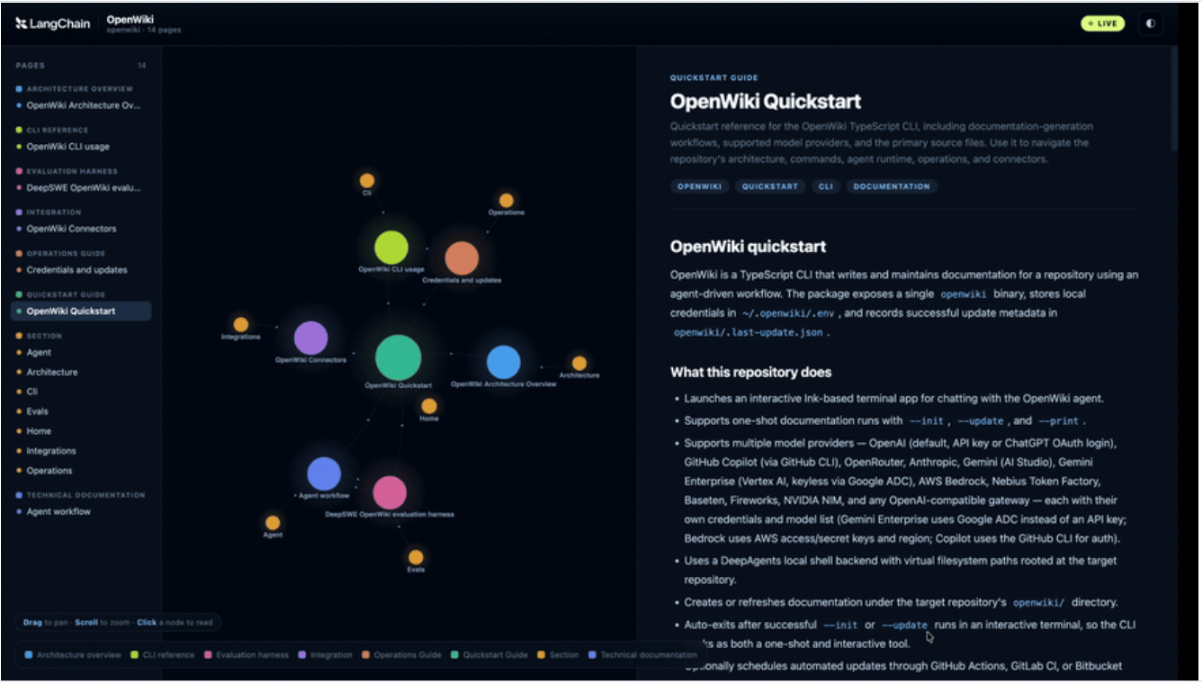
It also records trust metadata per page — which statements are backed by evidence in the code, and how strongly. Documentation that is confidently wrong is worse than none, and this layer exists to guard against that. For humans there is an interactive visualizer: a node graph of how the pages relate on the left, and the corresponding Markdown on the right when you click one.
Agent-written documentation: A documentation agent reads the codebase and produces a linked Markdown wiki, rather than a directory listing filled into a template.
Works inside your coding tools: It integrates with Codex, Claude Code, OpenCode and Cursor, borrowing the host’s model and repository tools instead of needing its own setup.
Updates from CI: Schedule it in GitHub Actions, GitLab CI or Bitbucket Pipelines so the documentation moves with the code.
Per-page trust: The OKF format records evidence and confidence for each page, marking which conclusions are grounded in the code and reducing the odds of documentation that lies.
Visual exploration: The bundled interface shows a node graph of page relationships beside a live Markdown reader, which is a fast way for a person to get the shape of a project.
Two modes: A `code` wiki for a repository, or a `personal` wiki for organising your own knowledge.
Model choice: Several model providers are supported, local Ollama among them, so nothing is tied to one vendor.
The docs are yours: The output is plain Markdown in your repository, readable, editable and deletable at any time, with no hosted service in the loop.
OpenWiki’s answer is to write that explanation down once as a wiki. It is a command line tool that has an agent read through your codebase and produce a set of linked Markdown pages meant to be read by coding agents as a manual for the project. The files land in your repository — your own Markdown, not something parked on someone else’s server.
This is not the same thing as conventional project documentation. Conventional docs are written for people and start going stale immediately; OpenWiki is written for agents to read and can be wired into GitHub Actions, GitLab CI or Bitbucket Pipelines to run on a schedule, so the pages follow the code.
It also records trust metadata per page — which statements are backed by evidence in the code, and how strongly. Documentation that is confidently wrong is worse than none, and this layer exists to guard against that. For humans there is an interactive visualizer: a node graph of how the pages relate on the left, and the corresponding Markdown on the right when you click one.
Features
Agent-written documentation: A documentation agent reads the codebase and produces a linked Markdown wiki, rather than a directory listing filled into a template.
Works inside your coding tools: It integrates with Codex, Claude Code, OpenCode and Cursor, borrowing the host’s model and repository tools instead of needing its own setup.
Updates from CI: Schedule it in GitHub Actions, GitLab CI or Bitbucket Pipelines so the documentation moves with the code.
Per-page trust: The OKF format records evidence and confidence for each page, marking which conclusions are grounded in the code and reducing the odds of documentation that lies.
Visual exploration: The bundled interface shows a node graph of page relationships beside a live Markdown reader, which is a fast way for a person to get the shape of a project.
Two modes: A `code` wiki for a repository, or a `personal` wiki for organising your own knowledge.
Model choice: Several model providers are supported, local Ollama among them, so nothing is tied to one vendor.
The docs are yours: The output is plain Markdown in your repository, readable, editable and deletable at any time, with no hosted service in the loop.