Description
#Open Source Hardware #ESP32 #XiaoZhiAI #xiaozhi-esp32 #MCP #Smart Home #MIT Open Source
xiaozhi-esp32 is an open source AI voice assistant project designed for the ESP32 series chips, capable of transforming a small development board into a true AI hardware that "can listen, speak, and control devices." The project is open-sourced under the MIT License and has received approximately 29,000 Stars on GitHub, covering a wide range of development boards and release variants, saving a lot of work for those who want to create their own AI speakers, desktop robots, or smart terminals from scratch.
Anyone who has tinkered with voice hardware knows that connecting wake word detection, speech recognition, large models, and speech synthesis is not difficult; the challenge lies in making the entire system work continuously with low latency and stability. xiaozhi-esp32 has integrated this chain, supporting ESP-SR offline voice wake-up, allowing for custom wake words, audio support for Opus encoding and streaming, and the ability to connect real-time end-to-end voice models, making the ESP32 not just "execute commands" but capable of natural real-time voice interaction.
AI Real-time Voice Interaction: Build a complete voice interaction chain around the ESP32, capable of handling voice input, AI processing, and voice output, making it more suitable for creating AI speakers, voice robots, and desktop assistants.
Offline Voice Wake-up: Supports ESP-SR, completing wake-up detection locally on the device without needing to send wake audio to the server each time, and supports custom wake words.
Streaming Audio: Supports Opus audio encoding and streaming, reducing the transmission pressure of voice data, and can connect to real-time end-to-end voice models, improving the waiting sensation often caused by traditional "ASR + LLM + TTS" chained solutions.
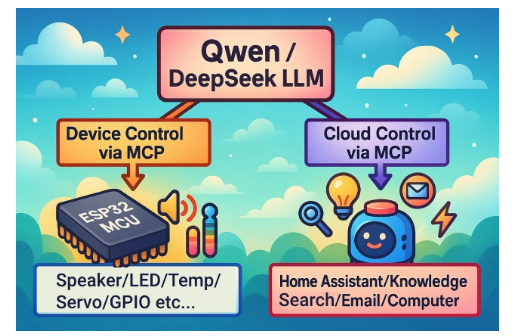
MCP Device Control: The project supports expanding device capabilities through the MCP protocol. The ESP32 side can operate speakers, LEDs, servos, and GPIO hardware, further turning AI responses into real device actions.
Connect More External Capabilities: Through server and MCP ecosystem, it can further expand smart home, desktop operations, knowledge search, email, and other functions, making the voice assistant not just a chat companion but also an interactive gateway between real devices and network services.
ESP32 Multi-chip Support: The project has a wide adaptation range, covering ESP32 as well as ESP32-C3, C5, C6, S3, P4 and other series, making it easy to choose hardware based on performance, cost, and peripheral requirements.
Rich Hardware Adaptation: The project repository already contains a large number of development board-related directories and different release variants, allowing for reference to existing hardware solutions and facilitating developers to port and redevelop based on their own boards.
Multiple Networking Methods: In addition to common Wi-Fi, it can also connect via wired Ethernet, USB RNDIS, 4G modules, and other methods, making application scenarios not limited to ordinary wireless network environments.
Multi-language Interface: The project provides rich interface language support, suitable for creating AI voice hardware for users in different regions.
MIT Open Source: The code is released under the MIT License, which is friendly for personal learning, DIY, hardware product prototyping, and secondary development. While people used to install an AI app on their phones, xiaozhi-esp32 is more like installing an AI "brain" directly into a small box on the desk.
xiaozhi-esp32 is an open source AI voice assistant project designed for the ESP32 series chips, capable of transforming a small development board into a true AI hardware that "can listen, speak, and control devices." The project is open-sourced under the MIT License and has received approximately 29,000 Stars on GitHub, covering a wide range of development boards and release variants, saving a lot of work for those who want to create their own AI speakers, desktop robots, or smart terminals from scratch.
Anyone who has tinkered with voice hardware knows that connecting wake word detection, speech recognition, large models, and speech synthesis is not difficult; the challenge lies in making the entire system work continuously with low latency and stability. xiaozhi-esp32 has integrated this chain, supporting ESP-SR offline voice wake-up, allowing for custom wake words, audio support for Opus encoding and streaming, and the ability to connect real-time end-to-end voice models, making the ESP32 not just "execute commands" but capable of natural real-time voice interaction.
Software Features
AI Real-time Voice Interaction: Build a complete voice interaction chain around the ESP32, capable of handling voice input, AI processing, and voice output, making it more suitable for creating AI speakers, voice robots, and desktop assistants.
Offline Voice Wake-up: Supports ESP-SR, completing wake-up detection locally on the device without needing to send wake audio to the server each time, and supports custom wake words.
Streaming Audio: Supports Opus audio encoding and streaming, reducing the transmission pressure of voice data, and can connect to real-time end-to-end voice models, improving the waiting sensation often caused by traditional "ASR + LLM + TTS" chained solutions.
MCP Device Control: The project supports expanding device capabilities through the MCP protocol. The ESP32 side can operate speakers, LEDs, servos, and GPIO hardware, further turning AI responses into real device actions.
Connect More External Capabilities: Through server and MCP ecosystem, it can further expand smart home, desktop operations, knowledge search, email, and other functions, making the voice assistant not just a chat companion but also an interactive gateway between real devices and network services.
ESP32 Multi-chip Support: The project has a wide adaptation range, covering ESP32 as well as ESP32-C3, C5, C6, S3, P4 and other series, making it easy to choose hardware based on performance, cost, and peripheral requirements.
Rich Hardware Adaptation: The project repository already contains a large number of development board-related directories and different release variants, allowing for reference to existing hardware solutions and facilitating developers to port and redevelop based on their own boards.
Multiple Networking Methods: In addition to common Wi-Fi, it can also connect via wired Ethernet, USB RNDIS, 4G modules, and other methods, making application scenarios not limited to ordinary wireless network environments.
Multi-language Interface: The project provides rich interface language support, suitable for creating AI voice hardware for users in different regions.
MIT Open Source: The code is released under the MIT License, which is friendly for personal learning, DIY, hardware product prototyping, and secondary development. While people used to install an AI app on their phones, xiaozhi-esp32 is more like installing an AI "brain" directly into a small box on the desk.