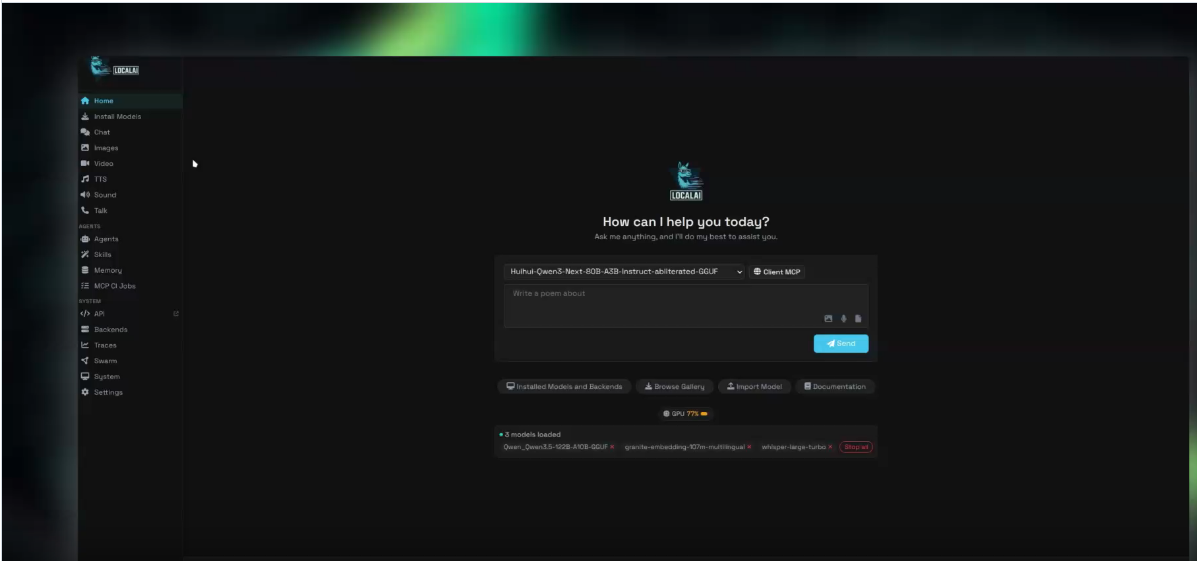
Description
#Local AI #Open Source Software #AI Server #OpenAI Compatible #Large Language Models #RAG #Agents #Windows #Linux #macOS
If your old computer running Windows at home is struggling, it would be a waste to just discard it. Instead, install LocalAI and transform it into a fully self-controlled local AI server.
LocalAI is an open-source local AI project under the MIT license that can run large language models, visual recognition, speech processing, image generation, and video-related models on your own computer or server. One of its biggest advantages is that it does not require a dedicated graphics card; it can run suitable quantized models even with just a CPU, depending on hardware performance.
It provides an interface compatible with the OpenAI API, allowing many chat panels, knowledge bases, and AI applications that originally called the OpenAI interface to connect to local models simply by modifying the interface address and key configuration, without the need for extensive code rewriting.
Pure CPU Operation: Can be used without an NVIDIA graphics card, allowing you to set up a local AI service using a regular desktop, mini PC, or idle old computer, although actual speed will be affected by processor performance, memory capacity, and model size.
Multi-type Model Support: Not only can it run LLM large language models, but it also covers visual, speech recognition, speech synthesis, image generation, and video-related capabilities, enabling a single service to handle multiple AI tasks.
OpenAI Interface Compatibility: Provides an OpenAI-style API, allowing existing chat front-ends, bots, knowledge bases, and shell projects to switch to LocalAI by simply adjusting the interface address.
Modular Backend: Different model running backends can be installed and loaded as needed, avoiding the need to cram everything into a large installation package, allowing for a deployment environment tailored to actual needs.
Multi-hardware Acceleration: Supports various hardware and acceleration solutions including NVIDIA, AMD, Intel, Apple Silicon, and Vulkan, while also retaining a pure CPU mode for easy adaptation to different devices.
Local Data Management: Models and inference services run on your own devices, so chat content, document data, and interface data do not need to be sent to third-party cloud services by default, making it more suitable for handling private data or internal materials.
API Key Authentication: Supports controlling interface access via API Key, suitable for LAN sharing, internal team calls, and multiple application access, avoiding complete exposure of services.
Quota Management: In multi-user scenarios, it can manage calling permissions and resource usage, reducing the problem of a single user monopolizing inference resources for long periods.
Agent Orchestration: Built-in capabilities related to agents allow models to combine tools, task flows, and external services to perform more complex automation operations.
RAG Knowledge Base: Supports retrieval-augmented generation, allowing local documents or business materials to be integrated into models for building private knowledge bases, enterprise Q&A, and document assistants.
Old Device Reuse: For old computers that are no longer suitable for daily office use but still have enough memory and storage space, LocalAI offers a low-cost reuse solution to turn them into LAN AI nodes.
Usage Reminder: Just because it can run on pure CPU does not mean all models will run smoothly; it is recommended to prioritize smaller parameter or quantized models and configure according to computer memory, CPU core count, and instruction set.
Official Website: https://localai.io/
GitHub: https://github.com/mudler/LocalAI
Open Source License: MIT License
Project Popularity: Reference information shows that the GitHub Star count has exceeded 26k; please refer to the project homepage for real-time data.
If your old computer running Windows at home is struggling, it would be a waste to just discard it. Instead, install LocalAI and transform it into a fully self-controlled local AI server.
LocalAI is an open-source local AI project under the MIT license that can run large language models, visual recognition, speech processing, image generation, and video-related models on your own computer or server. One of its biggest advantages is that it does not require a dedicated graphics card; it can run suitable quantized models even with just a CPU, depending on hardware performance.
It provides an interface compatible with the OpenAI API, allowing many chat panels, knowledge bases, and AI applications that originally called the OpenAI interface to connect to local models simply by modifying the interface address and key configuration, without the need for extensive code rewriting.
Software Features
Pure CPU Operation: Can be used without an NVIDIA graphics card, allowing you to set up a local AI service using a regular desktop, mini PC, or idle old computer, although actual speed will be affected by processor performance, memory capacity, and model size.
Multi-type Model Support: Not only can it run LLM large language models, but it also covers visual, speech recognition, speech synthesis, image generation, and video-related capabilities, enabling a single service to handle multiple AI tasks.
OpenAI Interface Compatibility: Provides an OpenAI-style API, allowing existing chat front-ends, bots, knowledge bases, and shell projects to switch to LocalAI by simply adjusting the interface address.
Modular Backend: Different model running backends can be installed and loaded as needed, avoiding the need to cram everything into a large installation package, allowing for a deployment environment tailored to actual needs.
Multi-hardware Acceleration: Supports various hardware and acceleration solutions including NVIDIA, AMD, Intel, Apple Silicon, and Vulkan, while also retaining a pure CPU mode for easy adaptation to different devices.
Local Data Management: Models and inference services run on your own devices, so chat content, document data, and interface data do not need to be sent to third-party cloud services by default, making it more suitable for handling private data or internal materials.
API Key Authentication: Supports controlling interface access via API Key, suitable for LAN sharing, internal team calls, and multiple application access, avoiding complete exposure of services.
Quota Management: In multi-user scenarios, it can manage calling permissions and resource usage, reducing the problem of a single user monopolizing inference resources for long periods.
Agent Orchestration: Built-in capabilities related to agents allow models to combine tools, task flows, and external services to perform more complex automation operations.
RAG Knowledge Base: Supports retrieval-augmented generation, allowing local documents or business materials to be integrated into models for building private knowledge bases, enterprise Q&A, and document assistants.
Old Device Reuse: For old computers that are no longer suitable for daily office use but still have enough memory and storage space, LocalAI offers a low-cost reuse solution to turn them into LAN AI nodes.
Usage Reminder: Just because it can run on pure CPU does not mean all models will run smoothly; it is recommended to prioritize smaller parameter or quantized models and configure according to computer memory, CPU core count, and instruction set.
Download Links
Official Website: https://localai.io/
GitHub: https://github.com/mudler/LocalAI
Open Source License: MIT License
Project Popularity: Reference information shows that the GitHub Star count has exceeded 26k; please refer to the project homepage for real-time data.