Description
#Visual RAG #Web Retrieval #AI Tools #Knowledge Base
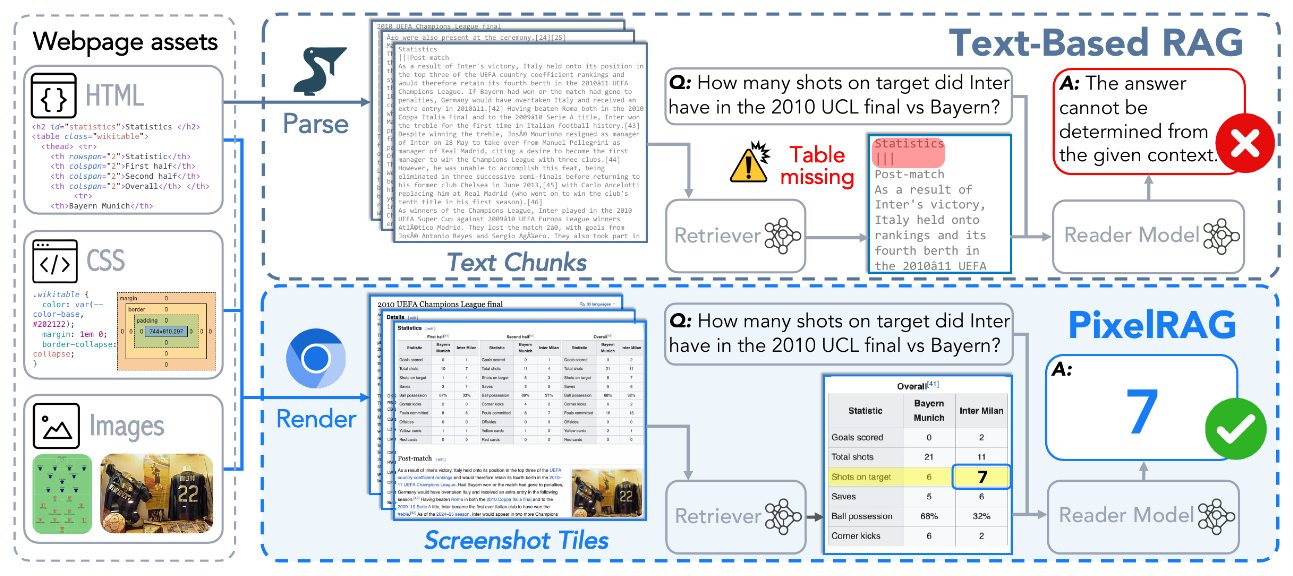
PixelRAG is an open-source RAG retrieval solution based on web crawling screenshots and visual models. Unlike traditional tools that first parse HTML and then extract plain text, it directly renders web pages, PDFs, papers, or local application interfaces into images, allowing visual models to understand and retrieve content from pixels. This approach retains information such as tables, charts, formulas, and layout structures that traditional text parsing processes often overlook, making the content retrieved by AI closer to what users actually see on the page.
The project employs a processing workflow of "page screenshot, visual embedding, vector indexing, visual retrieval," which can segment pages into image blocks and generate vectors using the Qwen3-VL-Embedding model optimized for screenshot data, saving them into a FAISS index. According to the official introduction, the team has also built a visual index containing over 30 million Wikipedia page screenshots and achieved good results in related plain text question-and-answer tests.
Pixel-level Web Retrieval: Does not rely on traditional HTML text parsing but directly indexes the content of rendered screenshots.
Retains Complete Page Information: Capable of recognizing tables, charts, mathematical formulas, images, and page layouts, reducing information loss caused by plain text extraction.
Supports Various Content Sources: Can handle regular web pages, PDF documents, arXiv papers, and visual content from local application interfaces.
Visual Vector Embedding: Uses Qwen3-VL-Embedding to vectorize page screenshots and fine-tunes for screenshot retrieval scenarios using LoRA.
FAISS Vector Index: Saves the generated visual vectors into FAISS, enabling similarity searches for large-scale page content.
Visual Question Answering Capability: Retrieval results can be analyzed by visual language models, allowing AI to answer questions directly based on the rendered page.
Claude Code Extension: The project provides relevant plugins that allow Claude to capture web pages, PDFs, papers, or local applications and perform retrieval and answering based on the screenshot content.
Reduced Parser Dependency: Bypasses complex and information-loss-prone HTML cleaning, body extraction, and format conversion processes.
More Flexible Model Upgrades: The index is built around the visual content of the page, reducing the cost of re-crawling and parsing the original page when switching to a stronger visual understanding model, with the need to rebuild the vector index depending on the embedding model and indexing scheme.
Completely Open Source: The project code is open, suitable for research on visual knowledge bases, web Q&A, paper retrieval, and multimodal RAG systems.
PixelRAG is an open-source RAG retrieval solution based on web crawling screenshots and visual models. Unlike traditional tools that first parse HTML and then extract plain text, it directly renders web pages, PDFs, papers, or local application interfaces into images, allowing visual models to understand and retrieve content from pixels. This approach retains information such as tables, charts, formulas, and layout structures that traditional text parsing processes often overlook, making the content retrieved by AI closer to what users actually see on the page.
The project employs a processing workflow of "page screenshot, visual embedding, vector indexing, visual retrieval," which can segment pages into image blocks and generate vectors using the Qwen3-VL-Embedding model optimized for screenshot data, saving them into a FAISS index. According to the official introduction, the team has also built a visual index containing over 30 million Wikipedia page screenshots and achieved good results in related plain text question-and-answer tests.
Software Features
Pixel-level Web Retrieval: Does not rely on traditional HTML text parsing but directly indexes the content of rendered screenshots.
Retains Complete Page Information: Capable of recognizing tables, charts, mathematical formulas, images, and page layouts, reducing information loss caused by plain text extraction.
Supports Various Content Sources: Can handle regular web pages, PDF documents, arXiv papers, and visual content from local application interfaces.
Visual Vector Embedding: Uses Qwen3-VL-Embedding to vectorize page screenshots and fine-tunes for screenshot retrieval scenarios using LoRA.
FAISS Vector Index: Saves the generated visual vectors into FAISS, enabling similarity searches for large-scale page content.
Visual Question Answering Capability: Retrieval results can be analyzed by visual language models, allowing AI to answer questions directly based on the rendered page.
Claude Code Extension: The project provides relevant plugins that allow Claude to capture web pages, PDFs, papers, or local applications and perform retrieval and answering based on the screenshot content.
Reduced Parser Dependency: Bypasses complex and information-loss-prone HTML cleaning, body extraction, and format conversion processes.
More Flexible Model Upgrades: The index is built around the visual content of the page, reducing the cost of re-crawling and parsing the original page when switching to a stronger visual understanding model, with the need to rebuild the vector index depending on the embedding model and indexing scheme.
Completely Open Source: The project code is open, suitable for research on visual knowledge bases, web Q&A, paper retrieval, and multimodal RAG systems.